The First Whisper
At exactly 9:00 p.m., behind a locked door on the second floor of a forty-five-million-dollar mansion, an eight-year-old girl was screaming into a pillow so no one would hear her.
Six nannies had already quit. The longest one lasted twenty-three days. The housekeeper wouldn’t say why — only that it happened “because of Lillian.” Doctors called it PTSD. Her father, a man who could end careers and lives with a single phone call, called it the one thing his empire couldn’t buy its way out of.
But Blair Vance, the seventh nanny, twenty-seven years old with nothing but a torn backpack and a childhood spent crying in rooms nobody entered — she heard something none of them had. That wasn’t grief behind that door. That was terror. Precisely timed. Every single night. Like a countdown.
And whatever Lillian Sterling was hiding, she would rather suffer alone in the dark than let it slip — because somebody had convinced a six-year-old that the wrong word, spoken out loud, would kill her father.
Blair didn’t know that yet. But she was about to open a music box that would blow this entire family apart.
The first thing Blair Vance noticed when she walked through the gates of the Sterling estate wasn’t the marble floors, or the paintings worth more than she’d earn in a decade, or the guards standing at every corner like they’d been carved from stone. It was the silence.
The wrong kind of silence. The kind that has no business existing in a house where an eight-year-old girl lives.
Blair was twenty-seven, broke, and carrying everything she owned in a backpack with a broken zipper. She’d just been hired as a nanny for the only daughter of Dominic Sterling — a man whose name made Wall Street executives sweat and made certain other men, the kind who dealt in favors and fear, lose sleep entirely. On paper, he ran a real estate empire out of Manhattan. Off paper, nobody talked about that if they wanted to keep breathing.
She’d expected wealth. She’d expected security cameras and NDAs. What she hadn’t expected was the housekeeper telling her, flat and unblinking, that six nannies had come and gone in two years. The longest one had lasted twenty-three days.
“Why did they leave?” Blair asked.
“Because of Lillian,” the housekeeper said. And something in her voice made it sound less like an answer and more like a warning she’d already given too many times to care about softening.
Lillian Sterling was small for her age. Gray eyes, same as her father’s. She moved through that enormous house like a ghost — quiet, careful, always watching corners before she walked into them. She didn’t throw tantrums. She didn’t misbehave. She ate breakfast alone at a table built for fourteen, went to school, came home, and vanished into her room before dark.
Then, at exactly 9:00 every night, she locked her door and cried.
Not the crying you’d expect from a child who’d lost her mother two years ago in what everyone called an accident. This was something else. Something that sounded like fear folded so many times it had nowhere left to go but out.
Doctors called it PTSD. Her aunt called it grief. Her father — the most dangerous man in the city — called it the one problem his money couldn’t fix.
But Blair, who had spent her own childhood crying in rooms where nobody came, heard something in that sound none of them recognized.
That little girl wasn’t grieving. She was afraid. And whatever was frightening her, she would rather suffer through it alone every single night than let anyone get close enough to find out what it was.
The next morning, Blair came down at six, a full hour before her contract required. She walked past oil paintings in gold frames, past a living room larger than the apartment she’d once shared with three roommates in Queens, and stopped in the dining room doorway.
Lillian was already there. Alone. One plate of toast. One glass of milk. Sitting with her spine perfectly straight, like she’d done this a hundred mornings before and expected a hundred more exactly the same.
Blair didn’t rush her. She pulled out the chair one seat away, opened a paperback, and read.
Twenty minutes passed in total silence.
Then, so quietly Blair almost missed it: “What book is that?”
“One about a girl who grew up alone in the woods,” Blair said, not looking up, not making it a moment. “She had to learn everything herself. No one to teach her.”
“Was she scared?”
“Yes. But she survived.”
Lillian didn’t ask anything else. But for the first time since Blair had arrived, the girl didn’t bolt from the table the second she finished eating. She sat there five more minutes, eyes drifting toward the book, before sliding down quietly and heading upstairs.
That evening, three black SUVs rolled up the drive like a funeral procession for someone who wasn’t dead yet. Dominic Sterling stepped out in a suit without a single crease, his face unreadable, his eyes sweeping the front of the house like he was checking for damage.
He paused for exactly two seconds when he saw Blair in the hallway. Looked at her shoes. Her ponytail. Said nothing to her. Turned to the housekeeper instead.
“Has she signed the confidentiality agreement?”
“Yes, sir.”
“Good.”
Then he walked upstairs to his office and shut the door. He didn’t ask what his daughter had eaten. He didn’t ask if she’d slept. He didn’t go anywhere near her room.
Lillian’s door: second floor, closed, dark. Dominic’s door: third floor, closed, light on.
Two floors. Two silences. Two people who shared a house and nothing else.
That night, Blair lay awake listening to the mansion fall asleep around her — footsteps fading, a door closing, a clock ticking somewhere in the walls.
At exactly 9:00, it started.
One choked sob. Then another, worse, being pushed into a pillow like Lillian was trying to swallow it whole before it escaped.
Blair knew that sound. She’d made that sound herself, years ago, in rooms where nobody came.
She got up. Walked barefoot down the hall. Sat outside a locked door she wasn’t allowed to open, and stayed there for two hours — not knocking again after the first “I’m fine, go away” — just present, just there, until the crying finally wore itself into silence.
What Blair didn’t know yet was that this wasn’t grief on a schedule.
It was fear with a countdown. And somewhere inside that locked room was the reason why — hidden in plain sight, waiting to be found by the one person who finally stayed long enough to look.
I know you’re curious to see what happens next, so please continue reading in the comments below. Thank you for your patience. Leave a “YES” below and give this post a Like if you want the full story. 👇
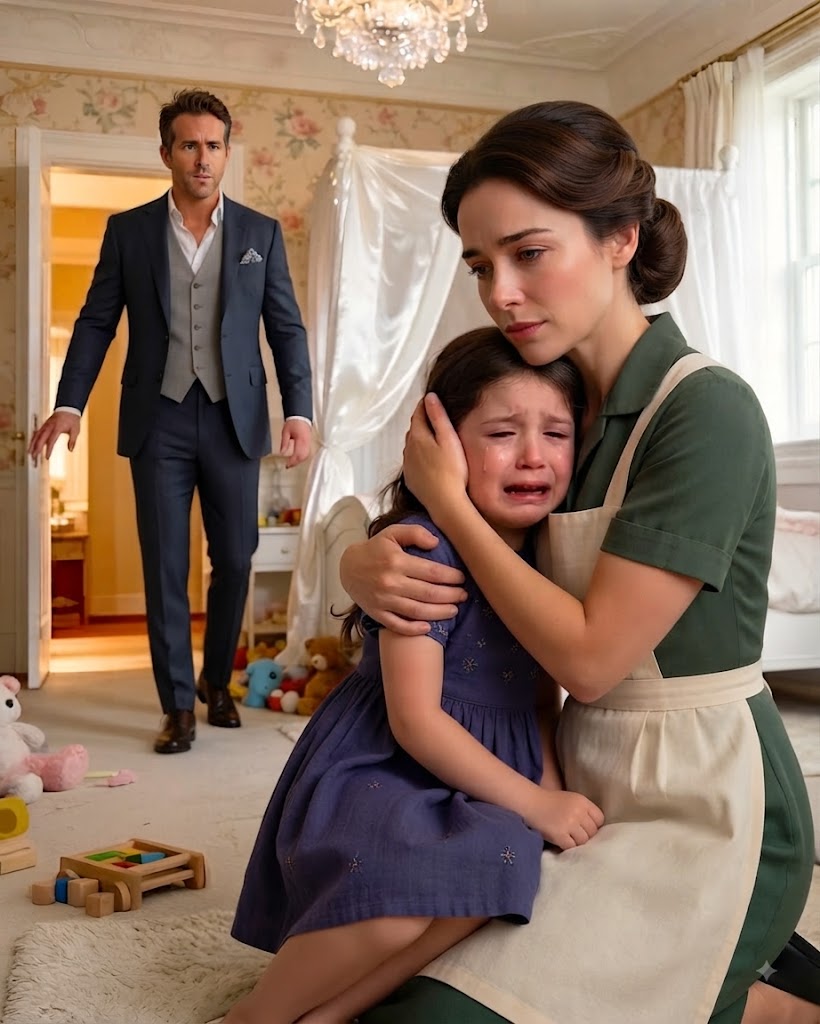
The grandfather clock in the downstairs hallway struck midnight with a dull, resonant thud that vibrated through the hardwood floors of the Sterling manor. Blair sat cross-legged against the corridor wall, her spine aching from the cold plaster, her eyes fixed on the heavy brass handle of Lillian’s bedroom door.
The crying had stopped an hour ago. Now, there was only the faint, rhythmic scraping sound of a small hand pushing something across the carpet inside.
Blair didn’t move. She had learned long ago that trust was not built on grand gestures, but on stubborn endurance. If you wanted a broken child to open a door, you had to prove to them that the monster outside was less terrifying than the cold silence within.
By 7:00 a.m., the household was stirring. The silent, efficient machinery of Dominic Sterling’s domestic staff began to hum. Housekeepers in dark uniforms polished silver doorknobs; security guards rotated their perimeter checks with military precision.
When Lillian finally opened her door at seven-thirty, dressed in her private school uniform with her gray tie neatly knotted, she didn’t expect to find Blair sitting on the floor, holding a small paper cup of warm chamomile tea and a plate with a single, perfectly toasted waffle cut into neat triangles.
Lillian froze, her hand still resting on the doorknob. Her gray eyes darted from the tea to Blair’s face.
“You’ve been here all night,” the girl whispered, her voice raspy from hours of crying into a pillow.
“Just outside,” Blair replied smoothly, standing up and brushing the lint from her jeans without making any sudden moves. “The floor is terrible for your posture, by the way. The architect who designed this place clearly never had to wait outside a stubborn kid’s room.”
A tiny, microscopic twitch pulled at the corner of Lillian’s mouth before she instantly forced her expression back into a rigid, defensive mask.
“My father says waiting around solves nothing,” Lillian said, repeating a line that clearly belonged to Dominic.
“Your father runs a real estate empire,” Blair countered, kneeling down so her eyes were level with the child’s. “I babysat feral raccoons in the Catskills for two summers. Trust me, patience works better than boardrooms.”
For a fraction of a second, Lillian looked like she wanted to smile. But then her gaze drifted toward the grand staircase behind Blair, and the warmth vanished from her face.
Footsteps echoed from the third floor. Heavy, deliberate, unmistakable.
Dominic Sterling was descending.
Chapter 2: The Crimson Ledger
Dominic stopped on the landing, his tailored charcoal suit catching the morning light pouring through the stained-glass dome above the foyer. His expression was a fortress of ice.
“Is there a problem, Ms. Vance?” Dominic asked, his voice a low, baritone rumble that commanded absolute obedience.
“No problem at all, Mr. Sterling,” Blair said, rising to her feet while keeping Lillian slightly behind her. “Just delivering breakfast.”
Dominic’s eyes swept over his daughter, lingering for a fraction of a second on Lillian’s reddened eyelids before snapping up to meet Blair’s steady gaze.
“Lillian does not require special accommodations,” Dominic said coldly. “She follows a schedule. The agency explicitly stated you were hired to manage her routine, not psychoanalyze her sleeping habits.”
“Routine is great when the world makes sense,” Blair replied, her voice refusing to tremble beneath the crushing weight of his scrutiny. “When it doesn’t, kids usually need someone who knows how to sit in the dark.”
Dominic stepped down the final two steps, closing the distance between them with intimidating speed. He towered over her, a man accustomed to breaking adversaries with a single raised eyebrow.
“You are here to watch her, Ms. Vance,” Dominic murmured, leaning in just enough for her to catch the faint scent of expensive cedar and gun oil. “Not to dig into things that do not concern you. The last nanny asked too many questions about my wife’s accident. She left with a generous severance and a broken lease. Do not make the same mistake.”
He didn’t wait for an answer. He turned on his heel, grabbed his leather briefcase from the foyer console, and walked out the front doors, the heavy oak slamming shut like a cell door.
Blair exhaled a breath she hadn’t realized she was holding. She looked down at Lillian, whose small hands were trembling against her pleated skirt.
“He thinks he’s protecting you,” Blair whispered gently.
Lillian looked up, her gray eyes shining with unshed tears that she was fighting a terrifying war to keep contained.
“He’s not protecting me,” Lillian whispered back, her voice shaking so badly the words barely formed. “He thinks… he thinks if I talk about what happened to Mom… the bad men will come for him next.”
Blair’s blood ran cold.
The pieces suddenly snapped together with the force of a falling anvil. The locked doors. The perfectly timed nightly panic. The guards. The paranoia.
Lillian wasn’t suffering from PTSD. She had been sworn to absolute, life-or-death silence. Someone—not her father, but someone whispering in the shadows of that multi-million-dollar empire—had convinced an eight-year-old girl that every word she uttered was a loaded gun pointed directly at her father’s heart.
Chapter 3: The Music Box of Secrets
That afternoon, while Dominic was downtown attending a closed-door board meeting, Blair convinced the housekeeper to let her organize the old storage room on the second floor—ostensibly to find spare art supplies for Lillian’s school project.
Instead, tucked behind a stack of velvet-lined jewelry boxes and forgotten ledgers, Blair found it.
A small, intricately carved mahogany music box. It didn’t play a lullaby. When Blair lifted the brass latch, a tiny, hidden compartment sprang open, revealing a micro-cassette recorder and a stack of printed threat letters bearing no return addresses, dated right up until the night of her mother’s “accident.”
And right on top, written in shaky, childish handwriting that matched Lillian’s, was a single list of rules:
1. Never tell Dad about the men in the garden. 2. Never say the word ‘blue car.’ 3. If anyone asks about the brakes, say Mommy did it herself. 4. If you cry out loud, Dad takes the blame.
Blair stared at the paper, the room spinning around her.
The crash wasn’t an accident. And Lillian hadn’t been crying out of grief—she had been counting down the hours, terrified that today would be the day she slipped up and got her father killed.
Before Blair could reach for her phone, the heavy iron front gates outside groaned open. Tires crunched on the gravel driveway much earlier than schedule.
A sleek black sedan had just pulled up to the front steps. But it wasn’t Dominic’s car.
Through the stained-glass window, Blair watched as three unfamiliar men in dark suits stepped out of the vehicle, bypassing the front guards with terrifying familiarity, and walked straight toward the front door.
The real siege of the Calloway estate had just begun. And Blair realized, with a sudden, chilling clarity, that she was locked inside a fortress with a target on her back—and a little girl who held the trigger.