MASTERPIECE OR MESS? Why ‘Crimson Desert’ Is the Most Divisive “Greatest Game Ever Made”
Is Crimson Desert the greatest video game of all time, or an unguided, story-lacking disaster?
Prominent gaming critics are officially calling it “the worst game I’ve ever enjoyed,” while hardcore RPG veterans are accidentally dumping 400+ hours into a massive, hidden second map suspended in the sky. Why is Pearl Abyss’s monster project simultaneously breaking every open-world record in history and driving casual players to refund it immediately?
The internet is completely divided. Find out why this game is tearing the community apart 👇🔥
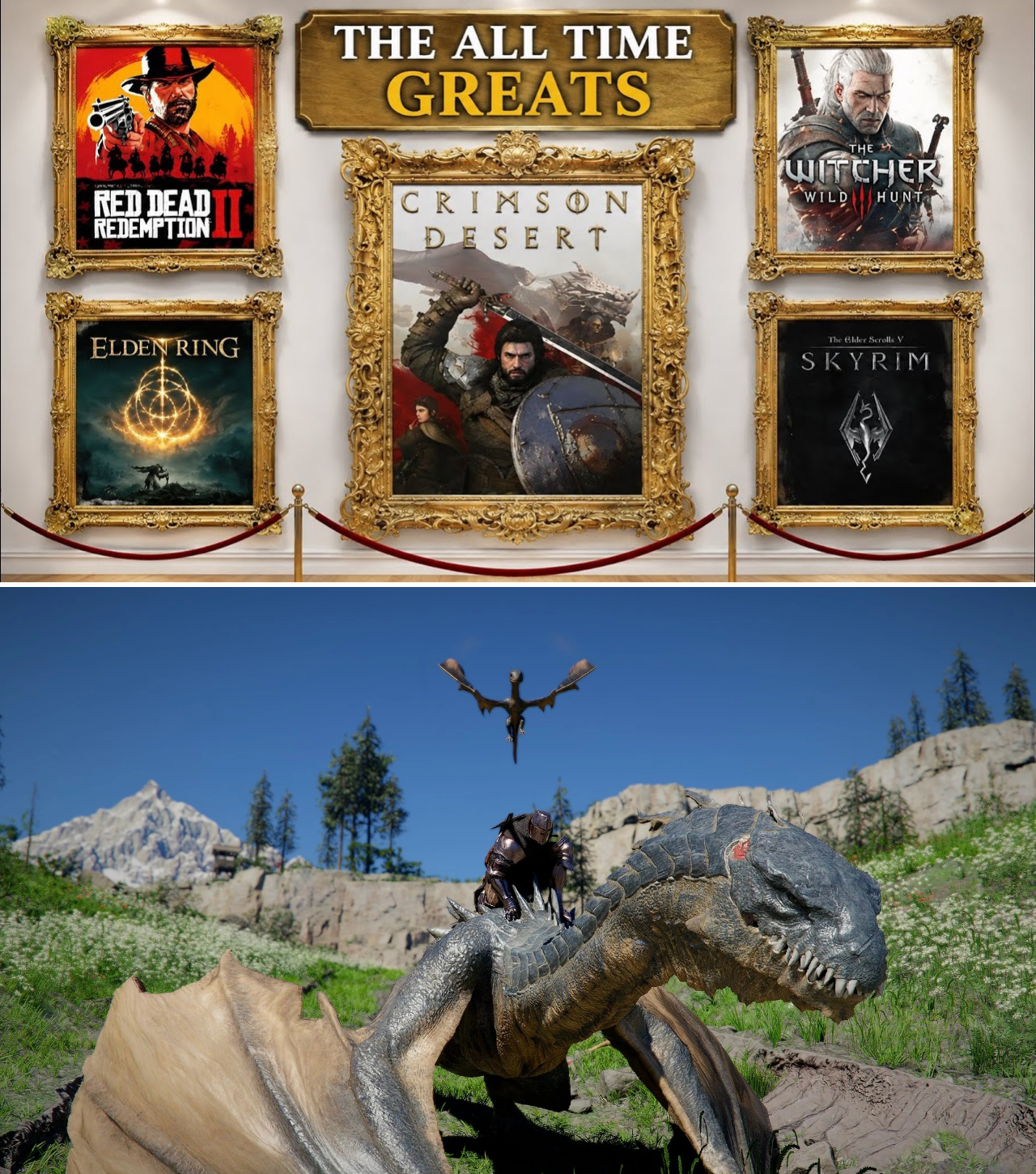
community engaged in a brutal civil war. The battleground is the continent of Pywell. The subject is Crimson Desert.
Since its launch, Pearl Abyss’s massively ambitious open-world RPG has dominated the global gaming conversation. Depending on who you ask, it is either the undisputed greatest video game ever created—a generational leap forward in open-world design—or an unfocused, poorly written sandbox that completely alienates its audience.
In an era where AAA titles typically hold your hand from the opening cutscene to the end credits, Crimson Desert essentially drops you into a hostile wilderness, hands you a sword, and walks away. For some, it is the ultimate expression of player freedom. For others, it is an overwhelming, frustrating mess.
Here is exactly why Crimson Desert is simultaneously making history and driving modern gamers completely insane.
The “Frankenstein” Game: Stealing the Crown
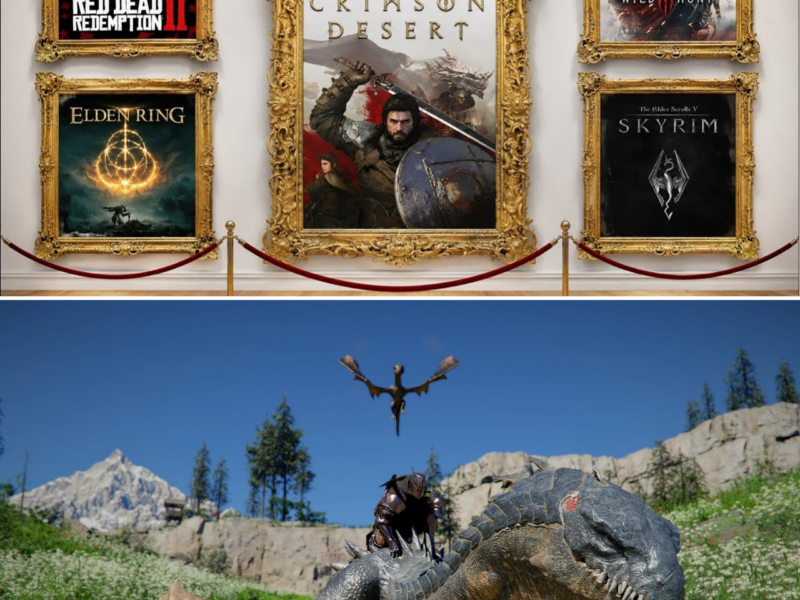
To understand why Crimson Desert is generating such fervent praise, you have to look at what Pearl Abyss actually built. Powered by their proprietary Black Space Engine, the developers didn’t just try to invent a new formula; they aggressively cannibalized the best elements from the greatest games of the last decade and stitched them into a single, staggering behemoth.
Did you love the “climb absolutely anything” mechanics and physics-based traversal of Zelda: Breath of the Wild? It’s here. Did you want the rich, dynamic side quests of The Witcher 3? They built 847 of them. Did you crave the punishing, diverse boss encounters of Elden Ring? There are 76 entirely unique cinematic bosses. Did you want the hyper-realistic world-building of Red Dead Redemption 2? NPCs literally have daily schedules, chop wood, attend church, and run regional trade economies.
Normally, when a studio tries to do everything, the game collapses under its own weight. But Pearl Abyss somehow made it work. Players can explore the map in a staggering number of ways: riding on horseback, piloting hot air balloons, taming and riding 29 different mounts (including dragons, flying Wyverns, and giant birds), or even commandeering fully weaponized mechs. You can use your Axiom Force to literally catapult yourself using trees.
The sheer audacity of the game’s scope is unmatched. It is a Frankenstein monster of gaming’s greatest hits, and it operates on a scale that defies logic.
A Scale That Shouldn’t Exist
The map of Pywell is incomprehensibly massive. Coming in at approximately 150 square kilometers, it is roughly four times the size of Skyrim and double the size of Red Dead Redemption 2.
But unlike games like Starfield or Assassin’s Creed Valhalla—which suffered heavily from empty, procedurally generated space or repetitive “copy-paste” assets—every inch of Crimson Desert feels meticulously hand-crafted.
The game is divided into five distinct regions, each with its own diverse biomes and architectural identities:
Hernand: Rolling grasslands, dense autumn woods, and towering castles.
Paloon: Brutal, snow-capped mountains and volcanic ruins.
Deminis: The sprawling metropolis of royal architecture.
Delysia: A bizarre, futuristic landscape where high-tech drones patrol rustic environments.
The Crimson Desert: Searing white sand dunes, ancient temples, and deep Amazonian-style jungles.
As if navigating over 430 unique points of interest and dozens of non-repeated settlements wasn’t enough, Pearl Abyss hid an entirely separate open world inside the game. “The Abyss” is a massive secondary map suspended high above the main continent, featuring floating islands, unique gravity puzzles, and exclusive boss fights. Because of the Black Space Engine, you can literally dive off an island in The Abyss and fall seamlessly into a bustling city in Hernand without a single loading screen.
The Second-Life Simulator
While the combat—which lets you swap between three entirely distinct playable characters (Cliff, Una, and Domain) on the fly—is phenomenal, the game’s true grip on the community comes from its simulation mechanics.
Players are sinking hundreds of hours into the game without touching the main storyline. Why? Because Crimson Desert contains entirely self-sufficient life simulators within it.
Do you want to abandon your life as a mercenary? You can buy a plot of land, gather seeds, and run a fully functional farming simulator. You can buy cattle from local traders and run a working ranch. You can recruit a crew of NPCs, assign them jobs, and have them physically travel the world to rebuild ruined cities like Paloon or construct bridges to create new shortcuts on the map.
You can fish, arm wrestle, gamble, investigate crimes, or play the dynamic stock-market-style banking system where prices fluctuate based on regional supply and demand. You can seamlessly switch from hacking a mech to pieces with a broadsword to dyeing your clothes and decorating your bedroom.
The Backlash: Why Is the Community Divided?
With all of these incredible features, how could anyone possibly hate Crimson Desert?
The answer lies in two major, highly polarizing flaws: the total lack of handholding, and an abysmal narrative structure.
Modern gamers have been conditioned over the last 15 years to expect map markers, glowing trails, and detailed UI prompts telling them exactly where the fun is. Crimson Desert violently rejects this philosophy. The game drops you into a massive world and essentially tells you to figure it out yourself. For players with limited time—adults who want a streamlined, guided experience after a long day at work—this design is agonizing.
Furthermore, the game’s actual writing is drawing fierce criticism. Prominent YouTube critics like Neon Knight (famous for his deep dives into The Witcher 3) recently went viral for dubbing Crimson Desert “the worst game I’ve ever enjoyed.”
For players who prioritize a gripping, cinematic narrative, the journey of the main protagonist, Cliff, is a disjointed mess. The opening hours are incredibly unfocused. You go from participating in an arm-wrestling match to sweeping a chimney with virtually no narrative glue holding the events together. The voice acting is wildly inconsistent, and the dialogue frequently falls flat.
If you play RPGs for the story, Crimson Desert will severely disappoint you. It is a sandbox first, second, and third. The story is merely a loose excuse to keep you moving across the map.
The Future: An Unprecedented Live Service?
What is perhaps most shocking about the Crimson Desert saga is how Pearl Abyss is treating the game post-launch. Unlike traditional single-player RPGs that release, drop a single DLC a year later, and fade away, Crimson Desert is being updated at a terrifying pace.
As of August 2026, Pearl Abyss has released a staggering 16 major updates in just a few months. These aren’t minor bug fixes. They are dropping massive, game-changing mechanics into the live game, including the ability to hatch and raise Wyverns, an entirely overhauled trading economy with 133 new trading posts, and continuous stealth additions that data-miners are constantly scrambling to uncover.
The developers have openly acknowledged the criticisms regarding the game’s weak storyline and have promised major narrative overhauls in the future.
The Verdict
Crimson Desert is not a game for everyone. If you need a linear, emotionally gripping narrative like The Last of Us, or if you get easily overwhelmed by having too many choices without a glowing arrow pointing the way, you will likely join the vocal group of players demanding refunds.
But if you are willing to let go of your modern gaming habits—if you are willing to just pick a direction, walk into the unknown, and let your curiosity guide you—you will find an experience that simply has no equal in the current market.
By taking the greatest mechanics from the greatest games of the 21st century and merging them into one seamless, loading-screen-free world, Pearl Abyss hasn’t just made a video game. They have built an alternate reality. And whether the critics like it or not, millions of players are never leaving.