The 1.0 Base-Building Lie: Hidden AI Tests Expose Why New Pals Are Sabotaging Your Factory
Everything you thought you knew about your Palworld 1.0 endgame base is completely WRONG. 🤯
Millions of players are furiously trashing their OG workers for shiny new 1.0 Pals, unaware that hidden AI and secret “Sanity” drain rates are actively sabotaging their factory lines. Which highly-hyped new Pals are absolute frauds, and which forgotten OG just proved it’s still the undisputed King of Kindling?
The empirical test results are tearing the min-maxing community apart. Find out who actually deserves a spot in your base 👇🔥
The launch of Palworld Version 1.0 brought a staggering amount of new content, weapons, islands, and most importantly, a massive roster of brand-new Pals. For the dedicated base-building community, this update was seen as a complete meta reset. Players immediately began dismantling their old, optimized production lines, eagerly replacing their tried-and-true Early Access workers with the shiny, high-stat newcomers introduced in the 1.0 patch. But a rigorous, highly empirical new test has just sent shockwaves through the community, proving that upgrading your workforce might actually be the biggest mistake you can make.
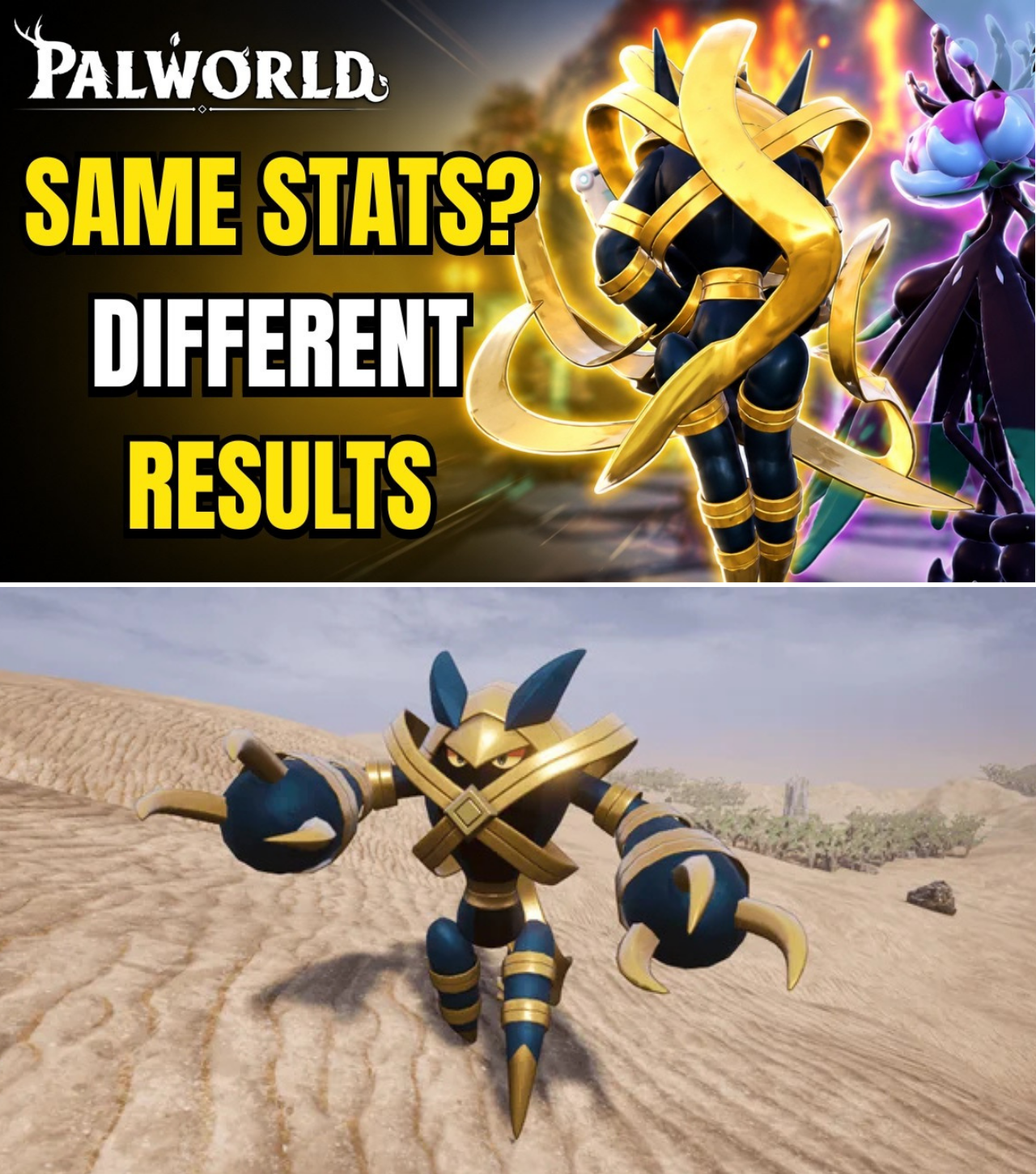
A viral breakdown by prominent community theory-crafters has exposed a glaring flaw in how players evaluate Pal efficiency. It turns out that the clean, straightforward stat sheets presented in the Paldeck are essentially lying. Hidden underlying mechanics—specifically Sanity (SAN) drain thresholds, AI eating animations, and travel time—are actively sabotaging the production of the new 1.0 Pals. In many of the most crucial base-building categories, the forgotten original generation (OG) Pals are still the undisputed kings of the factory floor.
The Brutal Testing Methodology
To definitively prove this massive discrepancy, theory-crafters pushed Palworld’s base mechanics to the absolute limit. The testing environment was designed to measure raw, unadulterated output under the harshest possible conditions over the span of three exact in-game days, starting from the precise moment the Pals woke up.
The core of the test revolved around the notorious Monitoring Stand. The stand was cranked to “Super Hard Working” mode—a brutal setting that drastically increases work speed but notoriously plummets Pal Sanity (SAN), traditionally leading to severe depression, injuries, and work stoppages. In Early Access, sustaining this mode was nearly impossible. However, Version 1.0 introduced new high-tier infrastructural countermeasures.
To keep the workforce from collapsing, the testing base was outfitted with stacked Alpha Wave Generators and Beta Wave Generators, which passively mitigate SAN drain, alongside the newly introduced Ancient Clinic to instantly resolve medical emergencies. For sustenance, the test subjects were fed an exclusive diet of Mozzarina Hamburgers, a premium food item that grants a massive +50% work speed buff.
The goal was simple: place the new 1.0 Pals against the Early Access champions in identical conditions, measure the exact resource output over three days, and average the results. The findings were nothing short of scandalous.
The Kindling Fraud: Why Incineram Refuses to Die
The most shocking revelation emerged from the Kindling category, a critical work suitability required for smelting endgame ingots. With the 1.0 update, players eagerly bred perfect versions of the new Kindling specialists, Magex and Lullu, assuming their updated stats would easily dethrone the old king, Incineram.
On paper, the new Pals should have won flawlessly. Magex, for instance, is programmed to eat when its Sanity drops to exactly 91%. Because it eats so early, it successfully maintains its Mozzarina Hamburger +50% work speed buff throughout its entire travel time to the feed box and back. Incineram, on the other hand, waits until its Sanity drops to a dangerous 86% before seeking food. Because of this delay, Incineram actually loses its food buff while walking to eat, suffering a period of unbuffed downtime.
Yet, when the three-day production numbers were tallied, the community was left speechless. Magex and Lullu tied, producing an average of 11,785 ingots. Incineram, despite dropping its food buff, produced a staggering 12,120 ingots—yielding nearly 2.69% more resources than its modern replacements.
How is this possible? The hidden AI work cycles and base animation speeds of Incineram are simply so violently fast and aggressive that it outpaces the newer Pals even when it loses its buffs. The raw mechanical coding of the OG Pal brute-forces its way to victory.
The Cooling Upset: Vanwyrm Cryst Holds the Line
A nearly identical scenario played out in the Cooling department, a vital task for endgame food preservation and base regulation. The highly hyped 1.0 newcomer, Smoky Cryst, was widely expected to become the new default Cooling Pal.
During the tests, Smoky Cryst exhibited behavior very similar to the veteran Vanwyrm Cryst. Both Pals suffered from poor SAN eating thresholds (dropping down to 84%), meaning both Pals lost their work speed buffs while traveling to eat. However, when the final numbers were calculated, the Early Access veteran reigned supreme once again. Vanwyrm Cryst produced an average of 11,714 resources over the three days, edging out Smoky Cryst’s 11,485 by a solid 2% margin.
The backlash on social media was immediate. On X (formerly Twitter), players expressed intense frustration. “I literally spent three days breeding a perfect Artisan, Work Slave, Serious, Lucky Smoky Cryst, condensed it to four stars, and butchered my old Vanwyrm Crysts to make room,” tweeted one furious player. “Finding out the new Pal is fundamentally worse because of hidden animation frames makes me sick.”
The Medicine Bloodbath: Wistella Takes the Crown
While the old guard maintained their dominance in Kindling and Cooling, the Medicine Production category saw a complete overhaul. Version 1.0 flooded the Paldeck with a massive roster of pharmaceutical candidates, leading to a crowded and highly competitive bloodbath between Venusa, Lullu, Wistella, Bakemi, Bellanoir, Dandelord, Magex, Whisper, and Gildra.
When the dust settled, Wistella emerged as the undisputed supreme medical officer, generating an impressive 8,735 resources. Wistella’s secret to success lies in its incredibly balanced AI. It triggers its eating cycle at 88% SAN, which is just high enough to ensure it never loses its food buff while traveling to the feed box, resulting in zero downtime over the three-day period.
Gildra put up a valiant fight, finishing at a painfully close second with 8,689 resources (only 46 behind Wistella), successfully maintaining its buff by eating at 90% SAN.
However, the test completely humiliated several other highly anticipated Pals. Bakemi, for example, was a catastrophic failure. Despite being the most “efficient” eater—taking only six meal breaks over the entire 72-hour period—Bakemi’s SAN threshold is coded to wait until 85%. This forced the Pal to constantly lose its food buff, dragging its overall production down to a miserable 8,396 resources, finishing dead last and a full 4% behind Wistella.
The True Version 1.0 Meta Roster
With the myths definitively busted and the hidden mechanics exposed, the hardcore base-building community on Reddit and Discord has finally assembled the mathematically perfect 1.0 endgame roster. If you want maximum efficiency on Super Hard Working mode, this is the indisputable layout:
Kindling: Incineram (Wins through raw, overpowering animation speed).
Cooling: Vanwyrm Cryst (Edges out Smoky Cryst in raw cycle efficiency).
Medicine: Wistella (The undisputed king of buff-maintenance).
Watering: Jellroy & Jelliette. (These new Pals must be used in tandem. By stacking their unique, intertwined Partner Skills, they create an unparalleled watering synergy that completely outclasses solo workers).
Planting & Gathering: Prunellia (Utilized for her dominant Partner Skill), supplemented strictly by Lullu for bases focused on Orchard Trees, as Lullu actively decreases crop growth time.
Electricity: Dazzi Noct.
Lumbering: Knocklem.
Transporting: Hydrolon. (Its massive model, combined with an enormous carrying capacity, completely trivializes base logistics and item hauling).
The Fall of Anubis and the Alpha Selyne Controversy
Perhaps the most dramatic shift in the entire meta involves the Handiwork and Mining category. Since the launch of Palworld’s Early Access, Anubis has been treated as a literal god of the factory line. Players bred tens of thousands of them, dedicating massive amounts of time to perfecting their passive skills.
In Version 1.0, Anubis is officially dead.
The crown has been stolen by Alpha Selyne. The reasoning, however, is highly controversial. Alpha Selyne currently possesses a Partner Skill that the community is widely describing as “fundamentally broken.” The mechanics governing Alpha Selyne’s work cycle heavily skew crafting and mining times in its favor, completely bypassing the standard mathematical scaling that holds Anubis back. Dedicated Discord servers are currently in a state of chaos as players furiously scramble to catch and breed perfect Alpha Selynes, terrified that Pocketpair might issue an emergency nerf.
Will Pocketpair Intervene?
The revelation of these hidden AI tests has ignited a fierce debate regarding game design and transparency. Dedicated min-maxers are demanding that Pocketpair standardize SAN drain thresholds and eating animations across all Pals, arguing that a Paldeck stat sheet should accurately reflect a creature’s actual in-game performance.
“It is fundamentally bad game design when a Pal with the exact same Work Suitability level performs significantly worse simply because it decides to wait 2% longer to eat a Mozzarina Hamburger,” complained a prominent moderator on the official Palworld subreddit. “We are essentially flying blind. We are breeding Pals based on lies.”
Whether Pocketpair will issue a hotfix to adjust these hidden eating cycles or reign in the broken dominance of Alpha Selyne remains a mystery. The developers have historically embraced the chaotic, emergent discoveries of their player base, often leaving quirky mechanics intact unless they actively crash the game.
Until an official patch is deployed, the overarching message for the Palworld community is clear: do not blindly trust the stat sheets, and think twice before you put your OG Early Access workers on the chopping block. In the ruthless, industrialized world of Palworld 1.0, hidden animations and Sanity thresholds are the only statistics that actually matter.