
The True Cost of Silence
My mother banned me from Thanksgiving on speakerphone, and my uncle laughed, “She can eat leftovers in the garage.”
They thought they were humiliating the broke, ungrateful daughter.
They had no idea their mortgage, utilities, phone plan, prescriptions, groceries, and Liam’s endless “rent emergencies” were all being paid from my debit card.
I was standing barefoot in my tiny kitchen when Mom delivered the punishment. I had forgotten to buy groceries for myself, so I was eating peanut butter from the jar while folding laundry.
Behind her voice, I heard dishes clinking and relatives laughing.
“You’re not welcome until you apologize to Liam,” she said.
Two weeks earlier, Liam had invited twenty relatives to a steakhouse to celebrate his new sales job. He spent the evening bragging about earning six figures, ordering bourbon flights, and discussing the luxury SUV he planned to lease because “image matters.”
Then dessert arrived, and he leaned toward me.
“Can you cover my rent again? Just until my commission clears.”
He already owed me for the previous month.
I quietly reminded him.
Liam raised his voice so the table could hear. “You act rich because you work with spreadsheets. You’re still living in a shoebox with a dying plant.”
Several people laughed.
I didn’t.
“Then someone with your income shouldn’t need money from someone living in a shoebox,” I said.
That was the humiliation my mother wanted me to apologize for.
On the speakerphone call, she said I had embarrassed him in front of the family.
“Family helps family,” she snapped.
I looked at the notebook on my counter where I had been calculating whether I could afford new work shoes before January.
“Does Liam have to apologize for mocking me?”
Silence.
Then Uncle Pete said, “Don’t make everything about you.”
Mom’s voice hardened. “Apologize, or stay home.”
Someone asked whether the turkey was ready. Liam laughed in the background and said, “She’ll come crawling back. She likes being needed.”
That sentence changed something in me.
Not loudly.
Not dramatically.
It was more like hearing a lock turn.
“All right,” I said.
Mom sounded almost disappointed that I had not begged. “All right what?”
“I won’t be there.”
I ended the call before she could answer.
Thanksgiving morning, Mom sent me a photograph of a paper plate wrapped in foil sitting beside the garage door.
Her message read: “Your father insisted we save you something. It will be outside until six.”
The turkey, stuffing, wine, and disposable serving trays in that photograph had been purchased through the grocery account linked to my card.
I did not drive over.
Instead, I opened my laptop.
For three years, I had paid their mortgage whenever Dad’s work slowed down. Then “whenever” became every month. I covered the utilities because Mom said late notices frightened her. I added my parents to my phone plan. I paid pharmacy charges and property insurance installments. When Liam claimed he was one missed payment away from eviction, I transferred money without telling anyone.
They called each payment temporary.
No one ever said thank you twice.
That weekend, I printed everything.
Thirty-six mortgage confirmations.
Utility statements.
Phone bills.
Pharmacy receipts.
Bank transfers labeled LIAM RENT, LIAM CAR, and LIAM EMERGENCY.
I printed Mom’s messages promising repayment. I printed Liam’s messages bragging about expensive dinners three days after asking me for money. I printed the grocery receipt for the Thanksgiving meal I had been forbidden to attend.
Then I placed every page into a thick black binder with labeled tabs.
MORTGAGE.
UTILITIES.
PHONES.
MEDICAL.
LIAM.
At the front, I added a summary sheet showing the total amount that had left my account.
Then I canceled every autopay tied to my debit card.
I did not announce it.
I did not threaten anyone.
I simply stopped volunteering to be the family’s invisible bank.
Friday morning, my phone began vibrating before seven.
Mom called six times.
Dad called twice.
Liam sent: “Whatever stunt you’re pulling, fix it now.”
The mortgage payment had been rejected.
The family phone plan was scheduled to close at midnight. The electric company had removed my card from the account. Liam’s rent transfer had not arrived.
By eight, Mom left a voicemail.
“You are trying to make us homeless over a joke. Come here immediately.”
So I did.
When I walked into my parents’ kitchen, every person who had laughed on Thanksgiving was waiting.
Uncle Pete stood beside the refrigerator with his arms crossed. Liam wore the expensive watch he had bought after telling me he could not make rent. Mom sat at the table with a printed mortgage notice in front of her.
My untouched foil-covered plate was still on the counter.
“Pay it,” Mom said, pointing at the notice.
No greeting. No apology.
Just an order.
Liam smirked. “You’ve made your point. Stop being dramatic.”
I set the black binder on the table.
The sound made everyone look down.
“What is that?” Dad asked.
“Three years,” I said.
Mom reached for it, but I placed my hand on the cover.
“Before I fix anything, Liam is going to repeat what he said about me at dinner. Uncle Pete is going to repeat the garage joke. And you’re going to explain why the daughter paying for this house was the only person not allowed inside it.”
Mom’s face tightened.
“We don’t owe you an interrogation.”
“No,” I said calmly. “You owe me considerably more than that.”
Then I opened the binder to the summary page.
Liam leaned forward, read the number, and stopped smiling.
But the total was not what made Mom go pale.
It was the signed message clipped beneath it—the one she had forgotten she ever sent.
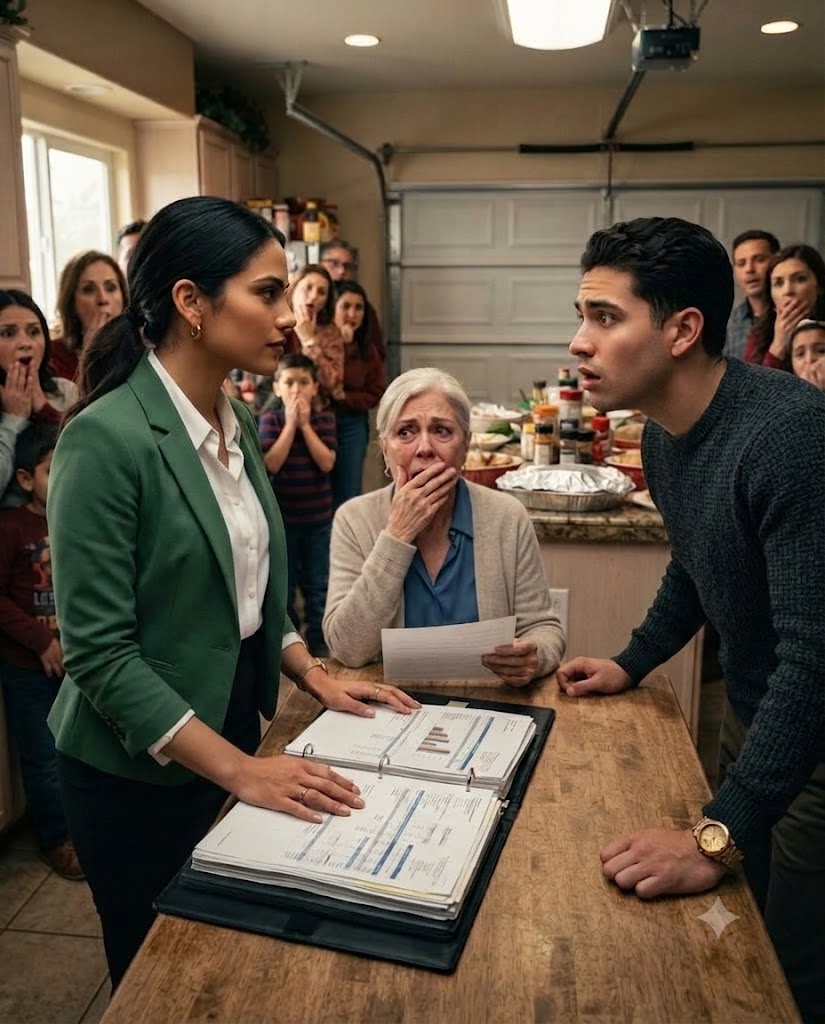
The kitchen air grew so thick with tension that even the refrigerator’s quiet hum sounded loud.
Mom’s eyes flicked from the bold-faced total at the top of the ledger—over one hundred and forty thousand dollars over three years—down to the small, laminated slip of paper clipped directly beneath it.
It was a screenshot of a text message she had sent me eighteen months earlier, during one of Liam’s phantom eviction crises: Just pay it for us this once, Chloe. God gave us a daughter with a good head for numbers because your father and I are cursed. We will pay you back every single cent when the pension clears, cross my heart.
The pension had cleared a year ago. They had bought a jet-ski for the lake house instead.
“Where… where did you get this?” Mom whispered, her voice losing its defensive edge, replaced by a sudden, frantic tremor.
“I keep records,” I said, my voice steady, stripped of the exhaustion that usually defined my interactions with them. “That’s what happens when you spend your life working in corporate compliance. You learn that people who demand blind trust are usually terrified of paper trails.”
Uncle Pete uncrossed his arms, shifting uncomfortably against the refrigerator. “Now hold on a minute, Chloe. This is a family matter. You’re airing dirty laundry over a petty spat about a Thanksgiving seat? So what if we joked a little? Families tease each other. It’s character building.”
I turned my gaze slowly toward my uncle. “Character building, Pete? Is that what you call telling your niece she can eat leftovers in the dirt outside while you sit inside eating meat I funded?”
Pete opened his mouth, but no sound came out.
Liam, sensing his absolute control over the narrative slipping through his fingers, slammed his palm against the kitchen table. The coffee mugs rattled.
“This is insane!” Liam shouted, his face flushing a furious, mottled red. “You’re acting like some kind of loan shark! You offered to help! You’re our sister—you wanted us to be comfortable! And now you’re ambushing us with a spreadsheet like a corporate auditor because you got your feelings hurt over a joke?”
I looked at my brother, really looked at him—the tailored shirt, the designer watch, the posture of a man who had never once paid for his own safety net.
“I didn’t ambush you, Liam,” I said quietly. “I simply stopped covering your blind spots. There is a profound difference. You’ve spent three years treating my bank account like an infinite ATM while mocking me for living within my means. You called my apartment a shoebox? At least I own every square inch of it. You don’t even own the shoes on your feet.”
Dad, who had remained silent at the end of the table, slowly pushed his glasses up his nose. His hands were shaking. He reached out, his calloused fingers trembling as they touched the edge of the black binder. He flipped a page, scanning the itemized pharmacy bills from the months he thought his insurance had covered entirely.
“Chloe…” Dad’s voice broke, raw and small. “The insulin… you paid for my prescriptions?”
“Every month, Dad,” I answered softly, a sudden, sharp ache blooming behind my ribs. “When the insurance cap hit in October, and you told Mom you were rationing your doses because money was tight, I transferred the balance to my pharmacy card. You told me not to worry about it, that you had handled it.”
Dad looked up, his eyes glassy with sudden, overwhelming shame. He looked across the table at Mom, who was staring fixedly at the formica countertop, refusing to meet his eyes.
The silence that followed was heavy, suffocating, and absolute. The illusion was completely dismantled. The effortless, upper-middle-class stability they paraded around extended family gatherings—the new cars, the expensive dinners, the country club memberships—wasn’t a testament to Liam’s hustle or my parents’ retirement planning. It was a structural illusion propped up entirely by a thirty-year-old woman eating peanut butter out of a jar in a twenty-two-thousand-dollar studio apartment.
“So,” I said, breaking the silence as I closed the binder with a sharp, definitive snap. “Here are your options.”
All four pairs of eyes snapped back to me.
“Option one: You call the mortgage company back, explain that your administrative error has been rectified, and I reactivate the auto-pay. But under one condition—Liam vacates the guest room by tomorrow morning, gets an apartment he can actually afford on his actual salary, and you all draft a legally binding repayment schedule notarized by an independent attorney.”
Mom’s head shot up, horror stamped across her features. “You want your own brother to sign a legal contract? We are your family!”
“Family helps family, right?” I echoed her own words back to her, my tone devoid of warmth. “Or does that rule only apply when I’m the one bleeding out financially?”
“And option two?” Dad asked quietly, his voice barely audible.
“Option two,” I said, stepping back toward the front door, “is that you let the bank foreclose. You let the utility companies cut the power. You let the repo men take Liam’s precious SUV. And the moment the house goes to auction, I use my remaining cash reserves to buy the deed out from under the bank at a fraction of the cost. I’ll evict every single one of you legally, change the locks, and turn this house into an investment property.”
Liam let out a harsh, disbelieving laugh, though sweat was beading visibly on his forehead. “You don’t have that kind of money! You’re a data analyst!”
“I’m a senior data analyst who hasn’t wasted a dime on luxury cars, designer dinners, or country club dues for the last ten years,” I replied, sliding my car keys off my wrist. “I have three hundred thousand dollars in liquid high-yield assets, Liam. More than enough to buy this place twice over.”
The color drained entirely from Liam’s face. The expensive watch on his wrist suddenly looked heavy, a useless anchor dragging him down.
I unlocked the front door, letting the crisp, cold autumn air flood into the suffocating warmth of the kitchen.
“I’ll leave the binder on the counter,” I said, resting my hand on the doorknob. “You have until five o’clock this evening to decide which option you prefer. Call me when you’ve figured out the math. After all…” I smiled faintly, looking back at the foil-covered plate sitting untouched on the counter. “…you guys love a good spreadsheet.”
I pulled the door closed behind me, stepping out into the bright afternoon sunlight.
My phone began buzzing in my pocket instantly—a relentless, frantic stream of notifications. I didn’t look at a single one. For the first time in three years, I walked down the driveway, got into my car, and drove away without a single weight on my shoulders.
The bank account was closed. The ledger was balanced. And the silence behind me wasn’t lonely anymore—it was just peace.