The Shadow of the Past
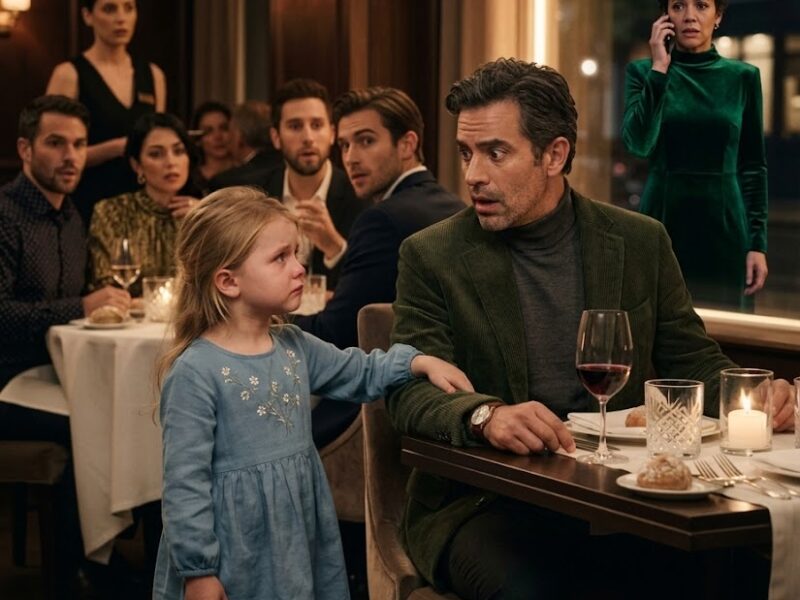
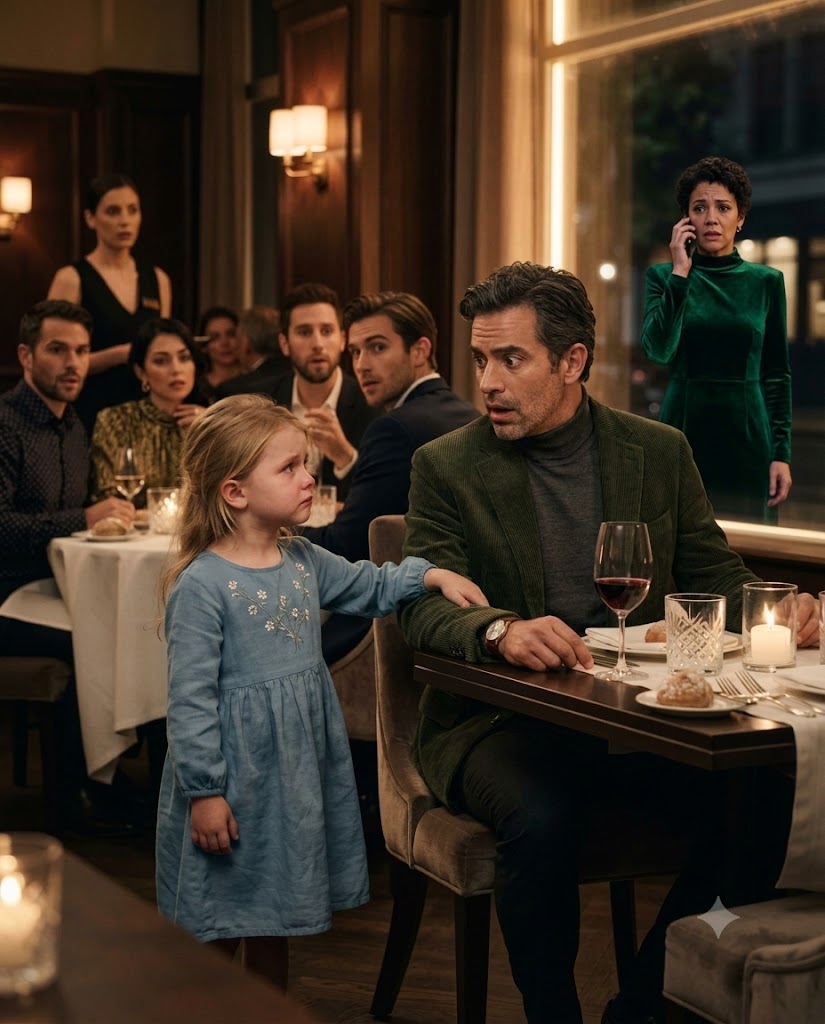
My blind date left me sitting alone in a crowded restaurant for forty-five minutes while strangers watched the empty chair across from me.
Then a four-year-old girl in a stained pink dress walked through the dining room, stopped beside my table, and said, “My mommy’s sorry she’s late. She’s outside crying because she thinks you’ll hate her.”
The hostess froze with a stack of menus in her hands.
The couple at the next table stopped whispering.
And I stared at the little girl as if she had just stepped out of someone else’s life and into mine.
“Are you Arthur?” she asked.
“Yes.”
She nodded with grave satisfaction. “Good. Aunt Beatrice said you were nice.”
At thirty-six, I had negotiated contracts worth millions without losing my composure. But I had no idea what to say to a child who had just appeared beside my abandoned place setting.
“What’s your name?”
“Sophie. My mommy is Clara. She had an emergency at work, and then the babysitter didn’t come. She tried to call you.”
My phone was still on silent in my jacket.
When I checked it, I found three missed calls and four messages from an unknown number.
I’m so sorry. Emergency at work.
The babysitter canceled. I’m trying to find someone else.
I can’t find anyone. I have to bring my daughter. I understand if you want to reschedule.
The final message had arrived two minutes earlier.
I’m outside with Sophie. We’re leaving. I’m sorry I wasted your evening.
Shame burned through me.
For the last forty-five minutes, I had been telling myself I had been rejected. I had imagined a careless woman laughing somewhere with her friends while I sat beneath Bellamere’s crystal chandeliers looking foolish.
But the woman outside had been fighting to get here.
And now her daughter was standing in front of me, defending her.
“Did your mother send you inside?” I asked.
Sophie’s confidence slipped.
“No. She said children aren’t supposed to be on fancy dates. But I saw you through the window. You looked sad.”
The honesty hit harder than it should have.
I had spent years building a life no one could criticize. Brennan Technologies had doubled in size after my father died. My house was immaculate. My calendar was full. My employees called me decisive, controlled, impossible to surprise.
Yet a four-year-old stranger had looked through a restaurant window and seen what no adult ever mentioned.
I was lonely.
“We should find your mother before she discovers you’re missing,” I said.
Sophie slipped her hand into mine as though the decision had already been made.
Her fingers were tiny and warm.
Every head seemed to turn as we crossed the restaurant together—the overdressed businessman who had been stood up and the little girl who had come to rescue his evening.
Outside, a woman in a simple navy dress paced beneath the golden light from the restaurant windows. Her dark honey-colored hair was coming loose around her face. One hand held a phone to her ear. The other trembled as she pushed her hair back.
“Beatrice, I ruined it,” she was saying. “I know you said he was kind, but nobody wants this kind of chaos on a first date. I’ll apologize tomorrow.”
Then she turned.
Her face went white.
“Sophie?”
The phone dropped to her side.
“Mommy,” Sophie announced, “I found Arthur.”
Clara hurried toward us and crouched in front of her daughter. “You cannot walk into a restaurant alone. Do you understand me? What if I hadn’t seen—”
Her voice broke.
She pulled Sophie into her arms and held her for one fierce second before looking up at me.
The humiliation in her expression was worse than anger would have been.
“I am so sorry,” she said. “This is officially the worst first impression in history.”
“I’ve had worse meetings.”
She blinked, unsure whether I was joking.
“I saw your messages,” I added. “Too late, but I saw them.”
“You don’t have to be polite.”
“I’m not being polite. I’m trying to understand why you’re standing outside instead of coming in.”
Clara glanced through the window at the candlelit tables.
“Because I was already late. Because I brought my child to a blind date. Because she has applesauce on her dress, I have been awake since five, and I spent the last hour trying to convince myself that walking through those doors would be brave instead of embarrassing.”
Sophie inspected the stain on her dress. “It might be yogurt.”
Despite herself, Clara laughed.
It was a tired laugh, but it changed her whole face.
“Have either of you eaten?” I asked.
Clara looked at me as if I had spoken another language.
“Dinner,” I said. “Have you eaten dinner?”
“No, but Arthur, this isn’t what you agreed to.”
“I agreed to meet you. You’re here.”
Sophie squeezed my hand. “And me.”
“And you,” I said.
For the first time that evening, Clara’s guarded expression softened.
But she still didn’t move toward the door.
“There’s something Beatrice didn’t tell you,” she said quietly.
The traffic hissed along the wet street behind us. Sophie leaned against her mother’s side. Inside, the hostess waited beside my table with two menus and one empty chair.
Clara took a breath, then looked directly at me.
“Before you invite us in,” she said, “you need to know the part that usually makes men leave.”
I know you’re curious to see what happens next, so please continue reading in the comments below. Thank you for your patience. Leave a “YES” below and give this post a Like if you want the full story. 👇
The wind off the harbor carried a sharp autumn chill, biting through my linen jacket, but I didn’t flinch. For a long moment, the hum of the city traffic and the muffled clatter of silverware from inside Bellamere faded into a white noise.
“Make it quick,” I said gently, keeping my voice level to mask the sudden, erratic thud of my own pulse. “Unless it involves a criminal record or an active bounty, I doubt it’s going to make me turn around.”
Clara bit her lower lip, her eyes searching my face as if looking for the trapdoor she was certain I’d drop through.
“I’m not divorced,” she whispered.
The words hung in the damp air between us. Across the street, the neon sign of a late-night pharmacy buzzed a rhythmic red.
“You’re separated?” I asked, my corporate instincts—honed by years of parsing vague corporate balance sheets—instantly searching for legal definitions.
“No,” Clara said, her chin lifting slightly with a defensive, weary pride. “I’m a widow. My husband, Julian, passed away four years ago. Exactly three weeks before Sophie was born.”
The sudden weight of her confession shifted the ground beneath my feet. I looked down at Sophie, who was busy trying to balance a smooth grey pebble on the toe of her scuffed sneaker, completely unaware of the ghosts haunting her mother’s shoulders.
“Beatrice didn’t mention that,” I admitted, my tone softening.
“Beatrice thinks I need to move on,” Clara said bitterly, her arms folding tightly across her chest as if she were trying to hold herself together. “She thinks three years of mourning is enough, that keeping my wedding ring locked in a drawer is a crime against my own youth. But she doesn’t understand. Every time I try to sit across from a man, every time someone asks what I do or where I live, the ghost of a life I was supposed to have sits right between us. I’m a package deal, Arthur. Not just a mother, but a woman permanently anchored to a ghost. Men don’t want a fixer-upper with a four-year-old and an empty tombstone hanging over the dinner table. They want easy. They want unencumbered.”
She turned her face away, staring into the dark glass of the restaurant window, bracing herself for the polite excuse, the calculated retreat, the swift handshake and the polite ‘it was nice meeting you’ that every other setup had ended with.
I didn’t step back. Instead, I took a half-step closer, the scent of lavender and rain drifting from her hair.
“Good thing,” I said quietly, “that I’ve never liked easy.”
Clara blinked, her tear-bright eyes snapping back to mine. “What?”
“If I wanted easy, I wouldn’t run a multi-million-dollar technology firm inherited from a father who demanded perfection before breakfast,” I replied, a faint, wry smile touching the corners of my mouth. “I like complex problems, Clara. And right out of the gate, you’ve given me a fascinating one.”
For three seconds, she just stared at me. Then, slowly, the defensive stiffness in her shoulders uncoiled. A genuine, breathless laugh escaped her lips, wiping away the exhaustion of the past forty-five minutes.
“You’re entirely insane,” she whispered.
“Completely,” I agreed, turning to offer my other hand to Sophie. “Now, are we going to stand out here freezing while you lecture me on your emotional baggage, or are we going inside to order the child whatever scandalous amount of chocolate cake she wants?”
Sophie’s eyes went wide with pure, unadulterated joy. “Chocolate cake?”
“Only if Mommy approves,” I said, looking back at Clara.
Clara took a deep, shuddering breath, wiped a stray tear from her cheek with the back of her hand, and looked from me down to her daughter.
“One slice,” Clara relented, a brilliant, unguarded smile finally breaking through her exhaustion. “And not a bite more.”
We walked back into Bellamere together.
The transition from the cold pavement into the warm, amber-lit dining room felt like crossing a threshold into an entirely different timeline. The ambient chatter of the restaurant seemed to quiet as we approached our table. The hostess, who had looked ready to clear my place setting five minutes earlier, hurried over with a look of stunned curiosity, deftly unfolding a third menu and clearing a spot for a high chair that Sophie cheerfully rejected in favor of sitting right beside me in the oversized leather booth.
We ordered. Not the pretentious tasting menu I had originally intended to suffer through alone, but a chaotic spread of wood-fired pizzas, appetizers, and a single, decadent wedge of chocolate lava cake that arrived with a sparkler stuck squarely in the middle.
The conversation didn’t follow the stilted, interview-style scripts of standard blind dates. We talked about the logistics of toddler daycare, the absurdities of corporate software architecture, and how Julian—a structural engineer who had loved old bridges—had once proposed to Clara on a rainy Tuesday in a cramped diner just three blocks from here.
She spoke of him without tears, only with a quiet, reverent warmth that made me realize something profound: she wasn’t trapped by her past; she was simply loyal to it. And a woman who could love a ghost that fiercely was a woman worth fighting for in the present.
By the time the plates were cleared and the check was paid—over Clara’s mild, principled protest—it was past nine o’clock. Sophie had fallen asleep halfway through her chocolate cake, her small head resting comfortably against my shoulder, her fingers loosely curled into the lapel of my jacket.
I walked them to Clara’s modest, dented hatchback parked around the corner. Carefully, I transferred the sleeping child into her car seat, shielding her head from the doorframe with my hand.
Clara stood by the open passenger door, her keys jangling slightly in her palm. The city lights caught the amber flecks in her eyes, making them look like polished glass.
“You know,” Clara said softly, looking down at the dark street before meeting my gaze, “this wasn’t quite how I planned my first date in four years.”
“If life went according to plan, nobody would ever meet anyone interesting,” I replied, leaning against the frame of her car. “Are you free next Tuesday? Same time, same restaurant. But this time, no babysitter cancellations allowed.”
Clara let out a soft, disbelieving breath, a smile spreading slowly across her face—not tired this time, but bright, hopeful, and entirely real.
“I’d like that, Arthur,” she said. “Very much.”
I watched her pull away from the curb, her taillights fading into the wet autumn dark as she drove toward the quiet suburbs, carrying her memories, her daughter, and a completely rewritten future.
When I finally turned to walk back to my own car, the solitude that had weighed on me for years felt entirely different. It wasn’t an empty room waiting to swallow me whole anymore. It was just a blank page, waiting for the next sentence.