THE ARCHITECT OF VOWS
The penthouse suite of the Waldorf Astoria smelled of white lilies and expensive champagne. Outside the floor-to-ceiling windows, the Manhattan skyline glittered like scattered diamonds against the ink-black night. It was the perfect backdrop for the perfect wedding night, purchased by the perfect husband.
Or so he thought.
“Rule number one, Audrey: when we disagree, my decision is final.”
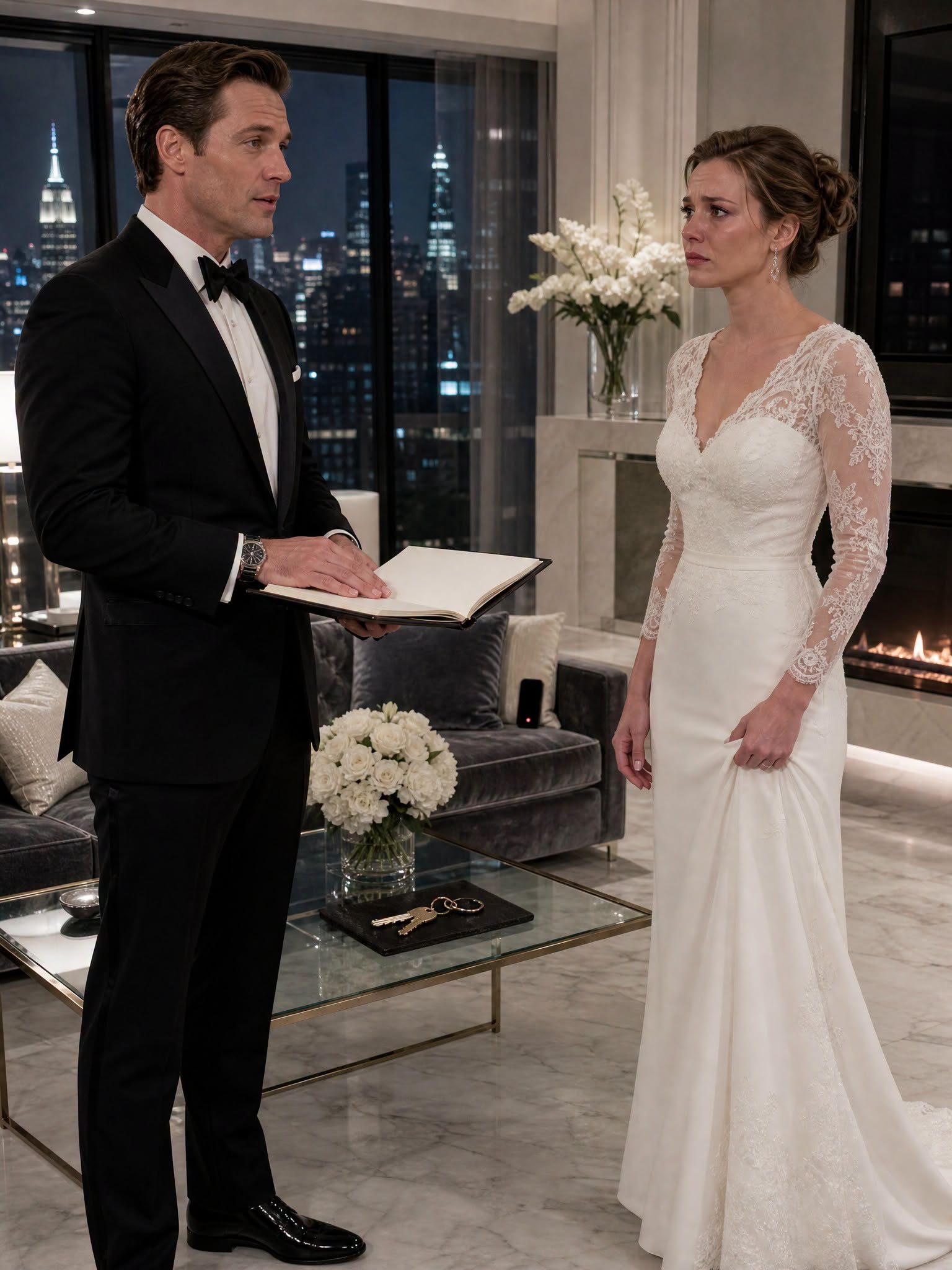
Dominic delivered the sentence with a polished smile that never reached his pale blue eyes. In one hand, he held a leather-bound notebook filled with handwritten rules. With the other, he tapped a silver pen against his thigh as though he were presenting the terms of an important business agreement—a hostile takeover, to be exact.
He interpreted my silence as uncertainty. He thought the quiet intake of my breath was the dawn of panic.
My attention moved past him to the velvet sofa. His phone rested against a decorative pillow, its camera facing the room, and the red recording indicator glowing softly beneath the screen.
Dominic had not simply prepared a conversation. He had prepared a performance. He wanted a recording of me appearing emotional, hysterical, or unreasonable—something he could later present to his lawyers, or perhaps my board of directors, without the full context if I ever questioned the arrangement he had planned. In his mind, he had cornered a deer. He thought he had married a woman who, driven by the desire to keep up appearances and desperate for love, would quietly nod and surrender her autonomy.
“Rule number two,” he continued, turning the page. The crisp sound of the heavy paper seemed violently loud in the quiet room. “Your salary will be deposited into a household account that I manage. I’ll decide the monthly budget, and you’ll request approval for anything beyond it.”
I remained entirely still. My jeweled wedding gown rested heavily around my feet, its long train stretching across the Persian rug. The dress weighed twenty pounds, encrusted with Swarovski crystals, and right now, it felt like a cage.
Only hours earlier, Dominic had stood beneath an arch of white roses, grasping my hands with feigned adoration, and promised our marriage would be built on equal partnership. He had looked into my eyes in front of three hundred of New York’s elite—my investors, my family, his so-called business partners—and vowed to protect me.
Now, the guests were gone. The music had ended. And he was reading instructions that had never been discussed with me.
“Rule number three,” he said, his voice dropping into a soothing, patronizing register that made my skin crawl. “Any major career decisions, specifically regarding the sale of your company’s shares, will require my counter-signature. We are a team now, Audrey. I’m simply protecting our future.”
I let the silence stretch. Ten seconds. Twenty. I watched him.
Dominic was undeniably handsome. It was how he got through life. Broad shoulders, a jawline carved from granite, and an Ivy League pedigree that opened doors before he even knocked. He worked in venture capital, or at least, he projected the illusion of working in venture capital.
“You’re quiet,” he noted, his smile widening slightly. He took a step toward me. “I know this is a lot to take in on our wedding night, sweetheart. But I need to know you understand. This is how marriages survive. Structure. Discipline. Trust.”
I finally moved.
Slowly, deliberately, I reached down and unbuckled the straps of my Jimmy Choo stilettos. I slipped them off, stepping onto the plush rug barefoot. The removal of the shoes wasn’t a sign of submission; it was the removal of a handicap. I needed to feel the ground. I walked past him, deliberately ignoring the notebook, and moved toward my overnight bag resting on the marble entryway table.
“Audrey, don’t walk away when I’m setting the boundaries,” he warned, a sharp edge bleeding into his meticulously crafted tone. He adjusted his posture to ensure his best angle was caught on the phone’s camera behind me.
I unzipped the side pocket of the bag. I pulled out a thick, manila envelope, sealed with red wax.
Without a word, I walked back to the center of the room and dropped the envelope onto the glass coffee table between us. It landed with a heavy, satisfying thud.
“What is this?” Dominic asked, his brow furrowing. The silver pen in his hand stopped tapping.
“I agree with you, Dominic,” I said, my voice smooth, quiet, and completely devoid of the hysteria he had been banking on. “Marriages do survive on structure. And trust. I just think we have very different definitions of both. Open it. Read the first page.”
He looked at me, then at the envelope, then briefly flicked his eyes toward his phone, likely calculating if opening an envelope would ruin his narrative of being the rational, dominant husband. Pride won. He set his leather-bound rulebook down, broke the red wax seal with his thumb, and pulled out the thick stack of documents.
I watched the exact moment his reality shattered.
It took precisely ten seconds.
His eyes scanned the first paragraph of the first page. The smug, polished smile slid off his face like wet paint. The color drained from his cheeks, leaving his skin a sickly, ashen gray. His jaw slackened. The silver pen slipped from his fingers, clattering loudly against the glass table.
“Where…” He choked on the word. He swallowed hard, his throat bobbing. “How did you get this?”
“Did you really think I built a billion-dollar cybersecurity firm by being unobservant?” I asked, tilting my head.
The document he was holding wasn’t a prenuptial agreement. He had signed one of those three months ago—or at least, he thought he did.
The document in his shaking hands was a forensic financial audit of Apex Capital, the offshore shell company he had been using to embezzle money from his own firm for the last four years. It detailed every wire transfer, every ghost account in the Cayman Islands, and every illegal kickback he had accepted.
“Rule number one, Dominic,” I said, my voice echoing coldly in the luxurious suite. “When we disagree, my decision isn’t just final. It’s legally binding.”
Six months ago, I had noticed the first red flag. It was a small thing. A discrepancy in a story he told about a weekend trip to Miami. He claimed he was at a tech conference, but his reflection in a photo posted by a mutual friend showed him on a yacht that belonged to Marcus Vance—a man currently under federal investigation for securities fraud.
Most women might have asked their fiancé about it. They might have cried, or demanded the truth, or gone to couples therapy.
I didn’t do any of that. I am a woman who codes algorithms that protect government mainframes. I don’t ask questions; I extract data.
I hired the best private investigators in the country. I ran deep-web background checks. I mirrored his devices. What I found was a man drowning in eight figures of hidden debt, desperate for a lifeline. He didn’t love me. He didn’t even like me. He targeted me. He needed a wealthy, seemingly docile wife whose assets he could slowly drain to cover his margins before his partners realized he was stealing from them.
“This is illegal,” Dominic stammered, his eyes darting frantically across the page as if hoping the ink would magically rearrange itself into something benign. “Hacking my private accounts. I could have you arrested.”
“You could,” I agreed, taking a step closer. “But you won’t. Because if you go to the police about my unorthodox data collection, I go to the SEC with the data itself. Do you know what the federal minimum sentence is for wire fraud of this magnitude, Dom? It’s twenty years.”
He stumbled backward, the back of his knees hitting the armchair. He collapsed into it, the documents trembling in his hands. “Audrey… wait. You don’t understand.”
“Oh, I understand perfectly. Keep reading. Turn to page four.”
His hands shook so violently he nearly tore the heavy paper as he flipped the pages. His eyes widened even further.
“Yes, that’s right,” I whispered, stepping into his personal space, looking down at him. “Your debts? The twelve million you owe to the Russian equity firm? The three million you borrowed against a house you don’t actually own? I bought them.”
He looked up at me, pure, unadulterated terror replacing the pale blue arrogance in his eyes. “You… you bought my debt?”
“Through a proxy corporation, yes. I am your sole creditor now, Dominic. You don’t owe anonymous loan sharks anymore. You owe me.”
I walked over to the velvet sofa. I picked up his phone. The red recording light was still glowing. I looked directly into the camera lens.
“Are you getting all this?” I asked the camera, offering a sweet, wifely smile. “I hope the lighting is okay.”
I turned the screen toward him. Dominic let out a strangled gasp.
It wasn’t just recording. The screen showed a live feed interface.
“I noticed you setting this up while I was in the bathroom,” I explained casually, tossing the phone back onto the sofa. “But I had already accessed your network an hour ago. You thought you were recording a video to your camera roll. But five minutes before you started your little monologue, I rerouted the destination. You aren’t recording, Dominic. You’re livestreaming.”
“To who?!” He screamed, losing his composure entirely. The polished venture capitalist was gone, replaced by a trapped, desperate animal.
“To a private, encrypted server,” I said, smoothing down the front of my wedding gown. “A server that is currently programmed to auto-forward the footage—along with the financial audit you’re holding—to your firm’s senior partners, the SEC, and the FBI, the moment I take my finger off a dead-man’s switch on my own phone.”
I held up my device. My thumb was pressed firmly against a biometric scanner on the screen.
“If I lift my thumb without entering my passcode, the emails send. If you try to take the phone from me, the emails send. If you hurt me, the emails send.” I tilted my head. “How’s that for a household budget, darling?”
Dominic put his head in his hands. A pathetic, whimpering sound escaped his throat. The leather-bound rulebook he had so proudly presented earlier had fallen to the floor, discarded and utterly useless.
“Why?” he choked out, looking up at me with tear-filled eyes. “If you knew all this… why did you marry me? Why did you walk down that aisle today? You could have just ruined me. Why go through with the wedding?”
I walked back to the glass table. I picked up his silver pen and his leather-bound notebook. I flipped past his handwritten pages of misogynistic drivel to a blank page.
“Because, Dominic,” I said softly, the silence of the room amplifying every word. “Ruin is boring. Ruin is quick. If I destroyed you publicly, you’d go to white-collar prison, play tennis for a few years, and write a memoir. You would eventually recover. I didn’t want you to recover. I wanted to own you.”
I began to write in his notebook. The scratch of the pen on paper was rhythmic and final.
“My company is about to go public,” I continued without looking up. “Having a messy, scandalous breakup with a fraudulent fiancé right before an IPO creates market volatility. It causes investors to doubt my judgment. I need a husband. I need a handsome, smiling, impeccably dressed accessory to stand next to me on red carpets, to attend charity galas, and to project the image of a flawless power couple.”
I finished writing, capped the pen, and tore the page out of the notebook. I let it flutter down onto his lap, right on top of the financial audit.
“What is this?” he whispered brokenly.
“Those are my rules,” I said.
He looked down at the page. I had only written three.
Rule Number One: You will resign from your firm on Monday, citing a desire to focus on philanthropic ventures. You will rely entirely on the allowance I provide you.
Rule Number Two: You will smile for the cameras, you will hold my hand in public, and you will play the role of the devoted husband flawlessly. If you step out of line, if you embarrass me, or if you attempt to leave, I release the files.
Rule Number Three: When we disagree, my decision is final.
Dominic stared at the paper as if it were written in blood. He was a man who had spent his entire life treating people like chess pieces. He had targeted me because he thought I was the queen—valuable, but ultimately meant to be sacrificed to protect his king.
He didn’t realize until this exact moment that I wasn’t a piece on the board at all. I was the one playing the game.
“You’re a monster,” he whispered, his voice trembling.
I laughed. It was a genuine, bright sound. “Don’t be dramatic, Dominic. I’m just a woman protecting her future. Isn’t that what you said? Structure. Discipline. Trust.”
I walked toward the bedroom doors, the heavy train of my dress whispering against the carpet. I stopped at the threshold and looked over my shoulder. He was still sitting in the armchair, a broken, hollowed-out shell of the man who had stood at the altar a few hours ago.
“Oh, and Dominic?” I said, my voice light and pleasant.
He didn’t look up, but his shoulders flinched.
“You can sleep on the sofa tonight. Be a dear and turn off the livestream before you go to bed. The wifi in this hotel is terribly expensive.”
I walked into the master bedroom and locked the heavy oak doors behind me. I set my phone on the nightstand, finally lifting my thumb from the screen. The dead-man’s switch deactivated with a soft chime. There was no livestream. There was no encrypted server auto-forwarding anything. The phone on the sofa had just been recording a standard video to his camera roll the entire time.
But a man driven by secrets is a man easily ruled by paranoia. Dominic would never risk testing my bluff. He was too terrified of the truth coming out.
I unzipped the back of my twenty-pound, crystal-encrusted gown and let it fall to the floor. I stepped out of it, feeling lighter than I had in months. I walked over to the minibar, poured myself a glass of twenty-year-old Macallan, and stepped out onto the private balcony.
The cold night air hit my bare shoulders, sending a rush of adrenaline through my veins. Far below, the city of New York pulsed with life—a grid of millions of people, millions of secrets, millions of transactions happening in the dark.
I took a sip of the scotch. It burned perfectly all the way down.
Tomorrow, I would have brunch with my new husband. We would smile at the paparazzi waiting outside the hotel lobby. He would open the car door for me, his eyes bruised with sleeplessness and defeat, and I would look at him with the radiant affection of a newlywed bride.
They say marriage is a contract. Most people just forget to read the fine print.
I raised my glass to the glittering skyline. The game was won. And for the first time in my life, I couldn’t wait for the rest of forever.