She walked to the window, the same window she had stood at just days ago, paralyzed by the fear that she would be a “lonely cat lady.”
The silence in the house was not an absence of sound, but a physical weight. Elena sat at her mahogany desk, the moonlight tracing the sharp, new angles of her jawline. Outside, the city hummed, indifferent to the fact that exactly one month ago, she had clawed her way out of a grave she had been digging for three years.
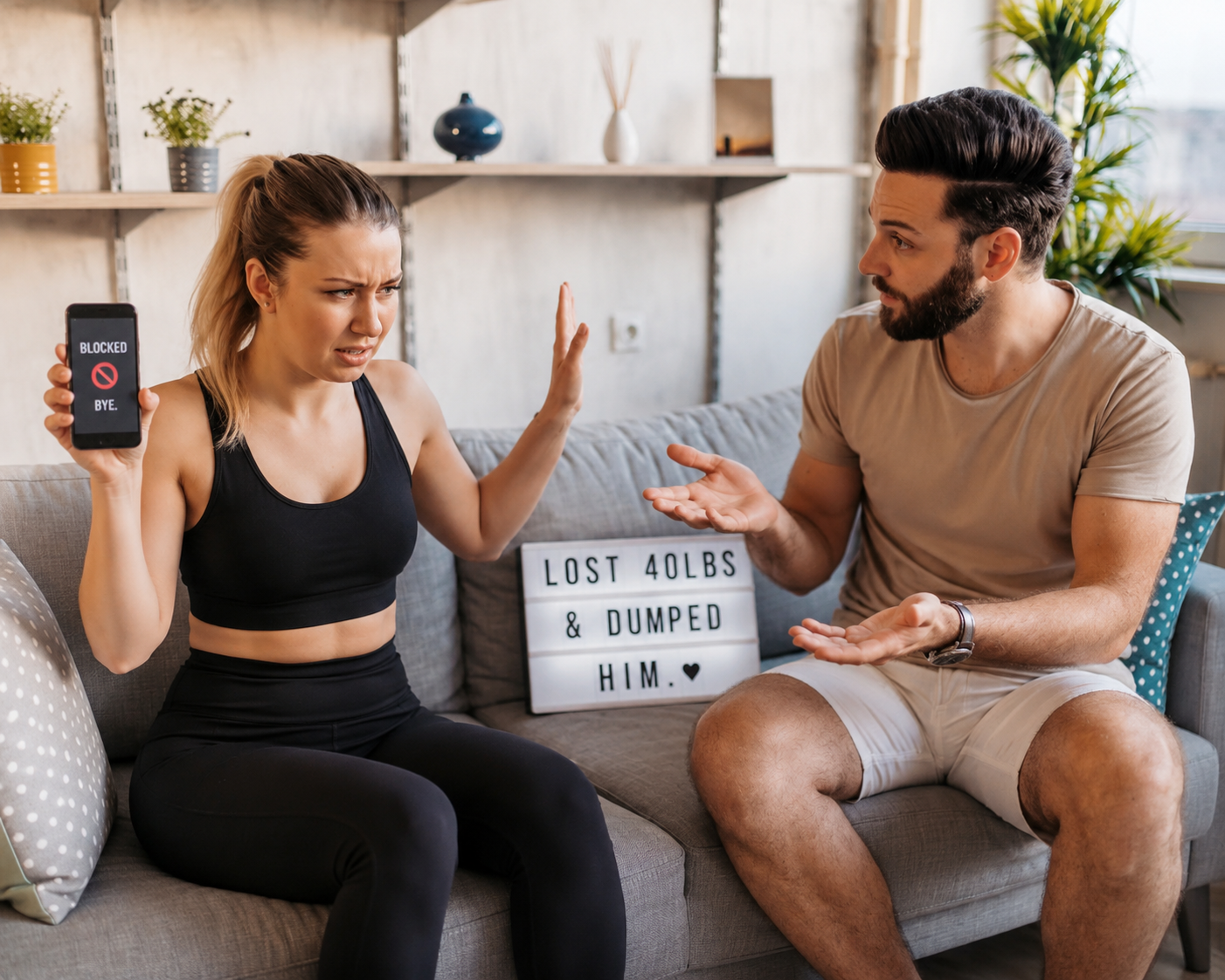
She held a glass of wine, her fingers steady. Six months ago, she wouldn’t have been allowed to hold it—he would have swiped it from her hand, lecturing her on “empty calories” while he drank cheap beer on her couch, his unemployed, stagnant presence draining the very air from the room.
Julian. The name felt like bile in her throat.
She took a sip, letting the velvet liquid settle. She remembered the day she finally realized he was nothing more than a parasite. It wasn’t the cheating—though that was a sordid, pathetic display of vanity. It was the moment he held the knife to her face. The way his eyes had gone flat, dead, as he whispered, “Look how easy it is.” He hadn’t been threatening a fight; he had been testing the limits of his own depravity.
But tonight, the walls were finally hers. Or so she thought, until a sharp, rhythmic thud resonated from the front porch.
Elena froze. Her security system—an investment she’d made the day after she escaped—remained silent. Her heart hammered against her ribs, a frantic bird in a cage. She moved to the monitor, her breath hitching. The porch was empty. But as she turned to leave, the motion sensor light flickered to life. There, taped to the door, was a single, bruised peach.
The air left her lungs.
The Anatomy of a Predator
She didn’t call the police. That was the trap. Julian loved the police; he loved the drama, the attention, the way he could manipulate a narrative to make himself look like the victim. No, she handled this herself. She grabbed the heavy fire poker from the hearth, its weight comforting in her palm.
She stepped onto the porch, the night air biting at her skin. The peach sat there, soft and yielding. Beside it, a note, scrawled in the frantic, jagged handwriting she knew better than her own.
“I can see you, Elena. You look better, but we both know the truth. You’re still just mine.”
He was watching. The realization sent a shiver down her spine that had nothing to do with the cold. How did he know where she was? She had moved three times since leaving him. Her job, her car, her life—it was all ironclad, or so she thought.
She retreated inside, locking the deadbolt, the chain, and the secondary bolt. She didn’t sleep. She sat in the center of her living room, the poker across her lap, her mind tracing the labyrinth of their history.
Julian hadn’t just been a boyfriend; he was an addiction. He had masterfully dismantled her reality until she believed that her body was a burden, that her career was a mistake, and that he—a forty-year-old man living in his parents’ basement—was the only one who could possibly love a “frumpy” woman like her.
He was a master of the “long con.” He had isolated her, systematically cutting off her friends by manufacturing crises that required her full attention. By the time she realized she was alone, he was the only person left in her world. It was a classic, cold-blooded maneuver.
The Mirror and the Trap
The next morning, Elena didn’t cower. She went to work, but she kept a file open on her second monitor: the paper trail she had been quietly building for months.
She had been tracking his digital footprint. Even a man who lives in his parents’ basement leaves a trail. She knew he had no car, no license, and no money, but she also knew he was obsessed with credit card churns and illicit forum gaming. He was a small-time grifter who thought he was a criminal mastermind.
She tapped into the security feed from her old apartment complex—she still had access due to a forgotten cloud sync. Her pulse raced. There he was, three days ago, buying a burner phone at a kiosk. She watched the footage, seeing his face—bloated, desperate, and twisted with a familiar, hungry rage. He wasn’t just stalking her; he was hunting her.
She felt a surge of cold clarity. The intrusive thoughts—the ones that told her she would be a lonely cat lady, that he would find someone better—were nothing but his voice, echoing in her subconscious. They were the malware he had installed in her brain.
She reached for her phone and made a call. Not to the police, but to a private investigator she had hired weeks ago, a man who specialized in high-stakes corporate disputes.
“I have the location,” she said, her voice steady. “He’s in the North District. He’s been using his mother’s car to track me. I have the plate.”
“Elena,” the investigator said, his voice grave. “He’s dangerous. You need to stay where you are.”
“I am where I want to be,” she replied, a faint smile touching her lips. “I’m not the victim anymore.”
The Final Confrontation
Three nights later, the rain was torrential. Elena sat in the dark of her living room, the only light coming from the streetlamp outside. She heard the soft clack of a latch. He was inside.
He wasn’t a master criminal; he was a desperate man who relied on the fear he had spent years cultivating. He moved through the house with a swagger that spoke of entitlement, his silhouette looming in the doorway of her office.
“I told you, Elena,” his voice was a low, oily purr. “You can’t hide.”
She stood up, not hiding behind the desk, but walking into the light. She was wearing a tailored suit, her hair pulled back, her eyes hard as diamonds. She looked like a woman who had never known a day of insecurity in her life.
Julian recoiled, his confidence flickering like a dying bulb. “You… you look…”
“I look like a woman who is done,” she said, her voice echoing in the vast, silent room.
He stepped forward, his hand reaching for something in his pocket—a knife, she suspected. “You think you’re better than me? You’re nothing without me. You’re just a frumpy—”
He stopped as the lights suddenly flooded the room. He blinked, blinded, and in that split second, the room filled with people. Her investigator, two police officers, and a paralegal holding a stack of papers so thick it looked like a manifesto.
“Julian,” the officer said, his voice devoid of emotion. “You’re under arrest for stalking, harassment, and violation of a protection order.”
Julian’s face went white. He opened his mouth, ready to spin a lie, to play the victim, to charm his way out of the hole. But as he looked around, he saw the camera recording his every movement, the documentation of his digital trail, the absolute, cold certainty in Elena’s eyes.
He didn’t have a car. He didn’t have a job. And now, he didn’t have a victim.
As they dragged him out, he looked back at her, his eyes wild. “They’ll leave you! You’ll be alone!”
Elena didn’t blink. She watched until the door closed, until the sound of his shouting faded into the steady rhythm of the rain.
The Architecture of a New Life
She walked to the window, the same window she had stood at just days ago, paralyzed by the fear that she would be a “lonely cat lady.”
She looked at her reflection. She saw the scars—physical and emotional—but she also saw the woman who had built an empire from the wreckage of a life he tried to destroy. She had a home, a career, and a future that was entirely, irrevocably hers.
She went to the kitchen and made a cup of coffee, the steam rising in the quiet air. She wasn’t just surviving. She was rewriting the narrative.
The fear that she would die alone was gone, replaced by the exhilarating, terrifying, and beautiful truth: she was finally alone, and for the first time, she was perfectly, blissfully whole.
She picked up the phone, not to check for messages, but to call a friend—a real friend, someone she had been too afraid to contact while he was in her life.
“I’m free,” she said.
And for the first time, she truly meant it.