THE PIRATE’S PILLAGE: How Steam’s Brutal Backlash, Corporate Greed, and ‘AC Shadows’ Pop-Up Ads Tanked the Launch of ‘Black Flag Resynced’
Ubisoft just scored a massive 100,000-player blockbuster hit on Steam—and immediately BLEW it up in a single day! Assassin’s Creed Black Flag Resynced was supposed to save the company after the historic AC Shadows financial disaster, but a brutal, unprecedented fan boycott is already tearing the game apart.
How does a near-flawless, highly anticipated remake tank into a “Mixed” review crisis within 24 hours of launch? Furious Steam users are exposing the dirty truth that review copies completely hid from the public: Ubisoft didn’t just slap a shameless $85 pay-to-win microtransaction store on a single-player game, they are actively locking cinematic cutscenes at a cinematic crawl and forcefully shoving non-stop, unskippable in-menu pop-up ads for their failed AC Shadows title directly down players’ throats while they’re trying to sail the high seas. Is this spectacular graphical masterpiece entirely ruined by desperate corporate desperation, or are gamers overreacting to optional store items? 👇
🔥 Read the shocking truth behind the explosive Steam review revolt destroying Black Flag Resynced here:
For a brief, shining moment, it appeared that the controversial French publisher Ubisoft had finally engineered its great corporate salvation. Following years of severe financial turbulence, declining stock values, and the historic underperformance of Assassin’s Creed Shadows—which drew a pathetic 20,000 concurrent players on Steam amid a wave of absolute public apathy and heavy financial losses—the company went back to its most reliable well.
The launch of Assassin’s Creed Black Flag Resynced, a full, stunning visual remake of the legendary 2013 pirate epic, initially looked like an unmitigated triumph. Within hours of dropping on Steam, the title comfortably achieved over 100,000 concurrent players, moving copies at five times the rate of AC Shadows and capturing the attention of mainstream critics who showered the game’s Anvil engine graphical upgrades with sparkling reviews.
Yet, as history routinely proves, Ubisoft possesses a unique, almost supernatural ability to snatch absolute reputational defeat from the jaws of commercial victory.
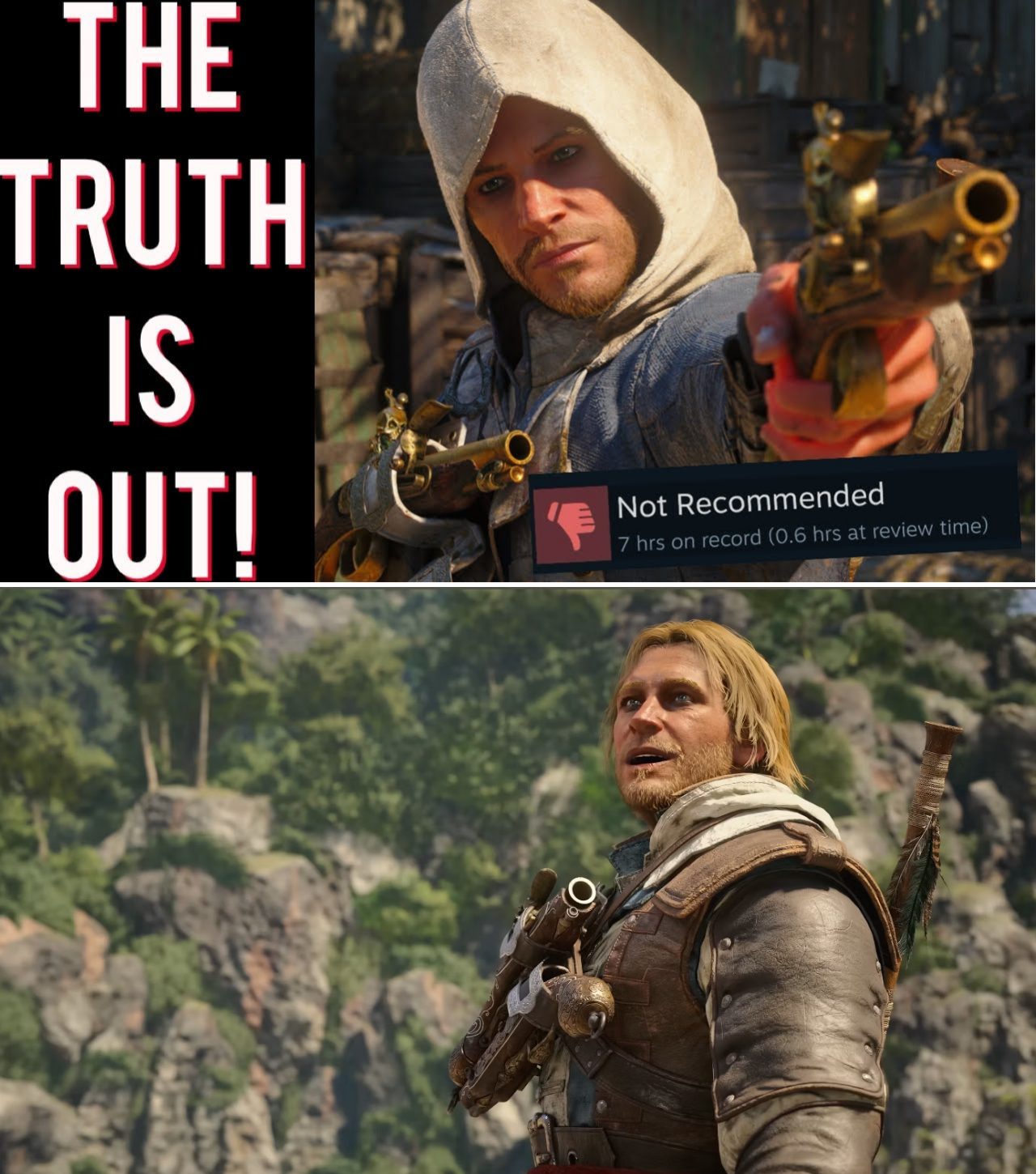
Within 24 hours of launch, a massive, highly synchronized consumer revolt completely broadsided the game’s Steam page. A deluge of negative player reviews rapidly dragged the title’s rating down into a highly volatile “Mixed” territory, sitting at a precarious 51% approval rating. Hardcore gamers, community commentators, and casual consumers are united in an absolute fury. The backlash has completely pulled back the curtain on a launch day bait-and-switch, exposing an aggressive monetization scheme, forced platform integration, bizarre technical performance locks, and a desperate corporate mandate that is forcefully shoving in-game advertisements for a failed, older product down players’ throats.
The Review Copy Deception: Hidden Day-One Microtransactions
As the initial wave of player feedback hit platforms like YouTube, X, and Reddit, an immediate and highly disturbing pattern began to emerge. Dozens of highly prominent gaming influencers and professional reviewers admitted they were completely blindsided by the game’s aggressive monetization because the microtransactions were entirely absent from the pre-launch review builds supplied by Ubisoft.
“I watched quite a few reviews before buying this, and absolutely nobody mentioned these microtransactions,” noted prominent community commentator YellowFlash 2 in a viral broadcast analyzing the Steam collapse. “It turns out Ubisoft likely waited until the day-one forced update to inject the real-cash store, completely bypassing the critical review window.”
When the retail public finally booted up the game, they discovered that even purchasing the premium Deluxe Edition did not grant them access to a massive array of launch-day content. Instead, the game features nine distinct, premium DLC shortcut and item packs costing an additional $85 combined—surpassing the retail price of the base game itself.
While some corporate apologists are defending the packs as entirely optional, “pay-to-journalist” convenience shortcuts designed to help busy players skip the resource grind, core fans are thoroughly disgusted. Steam reviewers are aggressively pointing out that the in-game economic progression has been noticeably re-balanced compared to the 2013 original, dramatically reducing the materials gained from naval boarding actions to artificially coerce frustrated players into entering the real-money store to upgrade the Jackdaw.
The Ultimate Insult: In-Menu ‘AC Shadows’ Advertisements
While predatory day-one microtransactions are an unfortunate staple of modern AAA gaming, Ubisoft introduced a highly provocative new irritation that has truly pushed the community over the edge. Hardcore single-player enthusiasts are reporting that the game’s primary menus and UI screens are heavily cluttered with aggressive, unskippable, and highly disruptive pop-up advertisements urging them to buy and play Assassin’s Creed Shadows.
The inclusion of these ads has been interpreted by the community as a supreme act of corporate desperation. Having lost hundreds of millions of dollars on Shadows, Ubisoft appears to be actively capitalizing on the massive, 100,000-strong player base of Black Flag Resynced to aggressively cross-promote and salvage their failed, politically divisive samurai title.
“I want a pure, traditional single-player experience where I can escape into an authentic pirate fantasy without having mid-game advertisements for AC Shadows forcefully shoved directly down my throat,” wrote one furious Steam user in a highly upvoted refund review. “Just because I am having a fantastic time playing a beautiful remake of a classic game does not mean I want to buy a completely unrelated, failed product that the entire community already rejected. It ruins the immersion completely.”
Technical Incompetence: The 30 FPS Cutscene Lock and Client Integration
Beyond the ethical quagmire of its monetization, Black Flag Resynced is also weathering severe criticism for baffling technical design choices. While the core gameplay beautifully utilizes advanced ray tracing, modern volumetric fog, and fluidly renders oceans at 60 to 120 frames per second on modern hardware, players quickly discovered that the game’s cinematic cutscenes are strictly locked at a sluggish, jarring 30 frames per second.
While some technical sleuths on Steam forums claim the 30 FPS cap is a severe day-one optimization bug tied directly to specific high-end Ray Tracing and BVH (Bounding Volume Hierarchy) quality settings, the lack of immediate polish has left PC enthusiasts deeply aggravated. In 2026, forcing a modern, premium-priced title to drop its frame rate in half every single time a narrative scene triggers is widely being condemned as absolute technical laziness.
Compounding this performance frustration is the mandatory, highly unpopular requirement for players to link their Steam purchases directly to the external Ubisoft Connect launcher application. Long a point of absolute detestation among PC gamers, the mandatory client wrapper has triggered a massive wave of immediate refunds. Players are reporting lost play points, connection errors that lock them out of their single-player campaigns, and severe background software optimization issues that cause the game to frequently crash directly to the desktop.
The Broken Paradox: A Visual Masterpiece Ruined by Corporate Mismanagement
The true tragedy of the Black Flag Resynced disaster is that underneath the suffocating layers of corporate greed, the development team actually delivered an incredibly faithful, mechanically brilliant remaster. When stripped of its monetization, the game is an absolute love letter to the golden age of the franchise.
The developers successfully ironed out the archaic, clunky structural flaws of the 2013 original. The sluggish, frustrating parkour mechanics that frequently caused Edward Kenway to get stuck on random tropical foliage or dense urban rooftops have been completely overhauled with smooth, highly responsive modern pathfinding. The naval combat remains the gold standard of the industry, delivering an experience that fans are openly contrasting against Ubisoft’s disastrous, long-delayed Skull and Bones multiplayer flop.
Yet, all of this phenomenal software engineering has been entirely overshadowed by the corporate directive. By treating a legendary, universally beloved single-player masterpiece as a live-service cash-grab and a billboard for their failed properties, Ubisoft has permanently poisoned what should have been their biggest public relations victory in a decade.
“They finally got a massive hit, but they had to go back to a 13-year-old masterpiece to get it because their modern creative direction is entirely bankrupt,” explained an industry analyst on X. “And even when they get a win handed to them on a silver platter by nostalgic fans, they simply cannot help themselves. They have to nickel-and-dime the consumer, shove ads in their faces, and ruin the entire goodwill of the product.”
The Horizon: An Unsustainable Stalemate
As the negative reviews continue to stack up on Steam, Ubisoft finds itself locked in a deeply problematic stalemate with its own consumer base. While the initial sales data indicates that Black Flag Resynced will be an undeniable financial success that will heavily cushion the company’s upcoming quarterly financial reports, the long-term cultural damage to the brand is catastrophic.
The “Mixed” review label on Steam serves as a permanent, highly visible scar that warns future buyers away from the title. It stands as a monumental cautionary tale for the modern gaming industry: consumers are no longer willing to silently accept beautiful graphics if they come packaged with predatory corporate ecosystem mandates.
Edward Kenway’s enduring legacy was defined by a pirate’s fierce, uncompromising refusal to bow to greedy, overreaching empires. The bitter, poetic irony of 2026 is that the very corporate empire that birthed him has become the greedy villain responsible for destroying his finest hour. Whether Ubisoft will execute an immediate course correction, patch out the forced ads, and fix the performance bugs remains to be seen—but for now, the community’s furious backlash has sent an unmistakable message across the digital sea: the era of silent consumer compliance is officially over.