THE CONTROLLER CONUNDRUM: Do Pro Settings Actually Make You Faster in Forza Horizon 6, or Are They Ruining Your Consistency?
🚨 EVERYTHING YOU KNOW ABOUT FORZA HORIZON 6 INPUT DELAY IS A LIE!
For years, you have been driving with an invisible handicap, subconsciously fighting your own controller triggers—and it is systematically ruining your lap times. A major community experiment just exposed a massive contrast between stock settings and “Pro” advanced calibrations, proving you can instantly shave an insane 0.25 seconds off a single 46-second lap. But there is a devastating, hidden catch: while your absolute peak speed explodes, your actual racing consistency might completely collapse into unforced errors—tap below to see the exact advanced deadzone charts and find out if you should actually risk switching! 👇
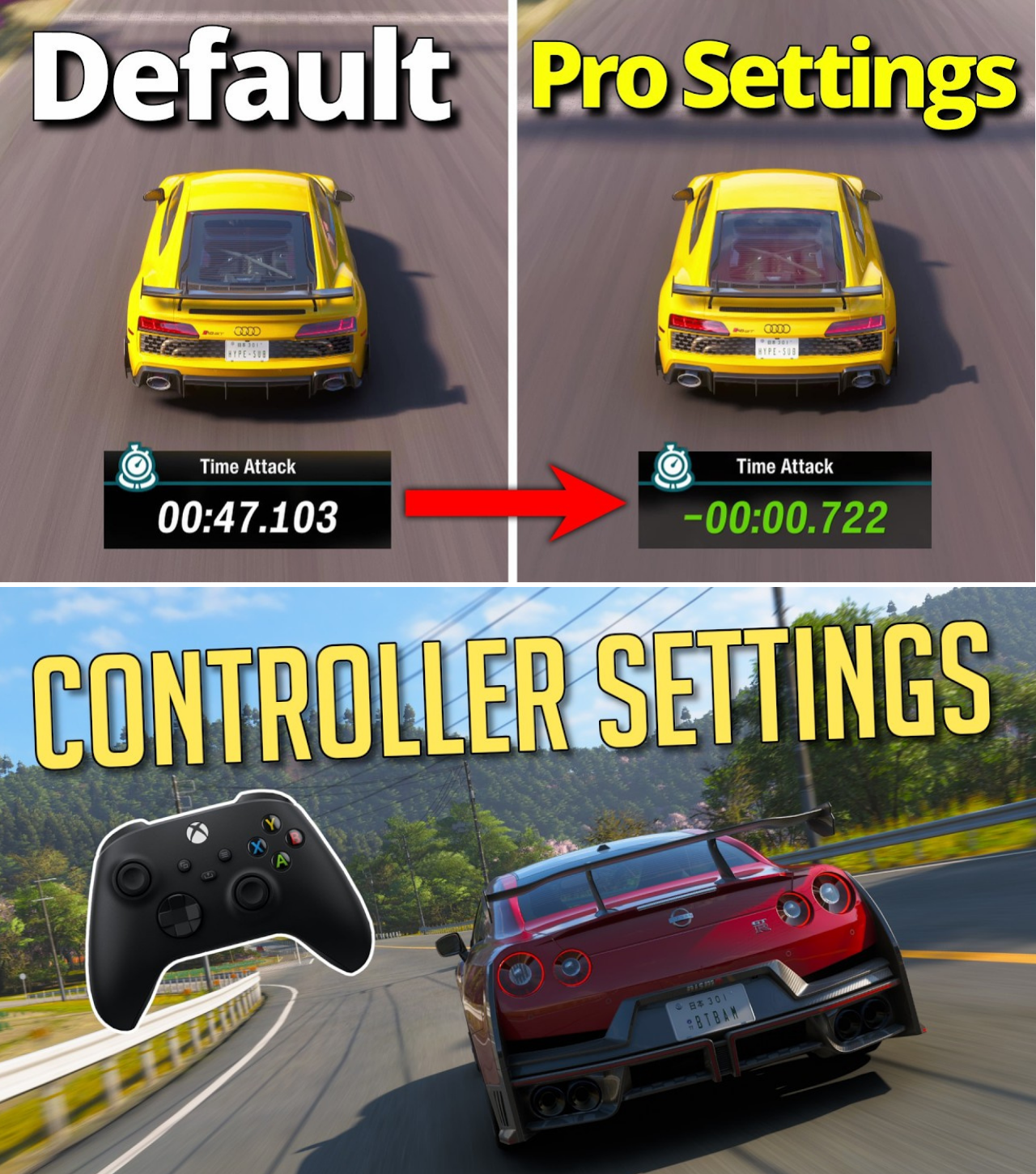
For years, casual racers and competitive esports drivers alike have accepted a universal truth in the racing genre: standard settings are a trap. For nearly half a decade, millions of players have booted up the franchise, unaware that they were driving with inherent, built-in artificial deadzones—essentially a digital “input delay” safety net implemented by developers to keep casual drivers from spinning out.
However, the launch of Forza Horizon 6 has brought this underlying technical debate to a boiling point. A viral technical investigation by prominent competitive player and content creator Mjay has officially shattered the community’s consensus, sparking an intense data-driven war across r/ForzaHorizon, Discord, and YouTube gaming circles.
The core question driving the controversy: Do elite “Pro” controller settings actually give you a competitive edge, or do they simply introduce a chaotic level of instability that ruins your average multiplayer performance?
The 0.25-Second Breakthrough: Eliminating the Ghost Input Delay
The drama ignited when Mjay conducted a grueling, 60-lap rigorous benchmarking test on a technical 46-second circuit, comparing standard factory-default settings against an underground “Pro” setup originally popularized by community tuning legend Johnson Racing.
The empirical data was staggering. By completely bypassing the game’s stock configuration and re-calibrating the advanced input sliders, Mjay recorded a peak lap time of 46.245 seconds—shaving a massive 0.25 seconds off the default control time. In the cutthroat realm of high-tier online multiplayer and leaderboard chasing, a quarter-of-a-second discrepancy on a short circuit is considered an absolute eternity.
“I can’t believe that I was using the default controls with input delay since I started playing Forza—literally for like five, six years I’ve been playing with input delay,” Mjay admitted to his audience, visibly stunned by the raw telemetry.
The secret behind this sudden burst of raw pace lies in the complete eradication of deadzones. Under standard factory settings, Forza Horizon 6 leaves an intentional padding at the beginning of trigger and thumbstick travel. This means a player must compress the right trigger (RT) or pull the left analog stick significantly before the game registers the input. The “Pro” layout strips this buffer completely bare, ensuring immediate, instantaneous mechanical execution.
The Double-Edged Sword: The Myth of Total Domination
However, as the telemetry sheets were analyzed deeper, a much more polarizing reality came to light. While the “Pro” settings allowed for an undeniably faster peak lap time, the overall 30-lap average data told a completely different story.
+--------------------------+------------------------------------+------------------------------------+
| Performance Metric       | Factory Stock Controller Settings  | Pro Advanced Deadzone Settings     |
+--------------------------+------------------------------------+------------------------------------+
| Fastest Peak Lap Time    | Slower Baseline                    | 46.245 Seconds (0.25s Faster)      |
| Driving Consistency      | Highly Stable / Predictable        | Volatile / High Unforced Errors    |
| Average Lap Multi-Lap    | Superior Overall Average           | Inferior Overall Average           |
| Mechanical Forgiveness   | High Safety Net                    | Zero Forgiveness                   |
+--------------------------+------------------------------------+------------------------------------+
According to community feedback and the test data, the extreme sensitivity of the zero-deadzone configuration makes Forza Horizon 6‘s physics engine incredibly punishing. Without the built-in developer buffer, every micro-twitch of a player’s thumb or minor hand tremor causes the vehicle to violently over-rotate or break traction.
“Although I achieved a faster lap time with the pro settings, my performance wasn’t as consistent, and my average lap times were actually worse,” noted an analytical commenter in a heavily upvoted breakdown of the telemetry. “With the stock settings, I was much more consistent and achieved better average lap times, even though my fastest lap wasn’t as quick.”
This statistical split has divided the community into two aggressive ideological camps. Casual-to-intermediate players on Reddit are actively warning against the switch, stating that “slow is smooth, and smooth is fast.” They argue that a control scheme requiring flawless, robotic precision is actively detrimental in chaotic multi-car public lobbies where avoiding collisions is more important than a fraction of a second.
The Definitive “Pro Meta” Configuration Exposed
For drivers willing to brave the hyper-sensitive learning curve in pursuit of raw leaderboard dominance, the community has consolidated the exact advanced control sliders required to mirror the pro meta.
The entire layout hinges on accessing the Advanced Controls menu tab and manually overriding the standard safety margins:
Steering Axis Deadzone Inside (0 – 3): Dropped almost to zero. If a player utilizes a high-end Hall-Effect or TMR controller, this can be set to absolute 0 for instant wheel response. For standard aging gamepads, a minimal value of 3 to 5 is recommended to counteract mechanical stick drift.
Steering Axis Deadzone Outside (100): Maximized completely to ensure the full physical travel of the analog stick translates to linear, predictable steering lock.
Acceleration & Deceleration Deadzone Inside (0): The core engine of the speed boost. Setting this to 0 means the absolute microsecond your finger touches the trigger, throttle or braking modulation begins instantly, giving unprecedented control over trail-braking and corner-exit acceleration.
Acceleration & Deceleration Deadzone Outside (100): Kept at max value to allow for the widest possible physical modulation range, preventing the triggers from acting like digital on/off switches.
Drifters and Purists Cry Foul
The debate has twisted even further as specialist communities within Forza Horizon 6 chime in. While circuit racers are finding massive value in the hyper-responsive cornering adjustments, the grassroots drifting community has voiced extreme frustration.
In separate drift trials utilizing high-power builds like the Mazda “Mad Mike” replica, the pro settings proved to be an absolute nightmare. Drifting requires constant, smooth counter-steering adjustments to hold a continuous slide. Under the hyper-sensitive zero-deadzone meta, the car becomes violently twitchy, over-correcting with the slightest input and forcing the driver to constantly fight the wheel just to keep from spinning out out into a wall.
Furthermore, veteran players point out that changing deadzones is completely useless if a driver refuses to turn off basic assists. The true community consensus remains that true speed in Forza Horizon 6 cannot be achieved on an automatic transmission; unlocking maximum velocity requires stepping up to Manual or Manual with Clutch (utilizing a button-swap to map the clutch directly to the A button for easy thumb-swiping across X and B).
The Verdict: Who Should Switch?
As Playground Games continues to balance the game’s evolving physics mechanics, the controller settings debate serves as a stark reminder of the depth hidden beneath the game’s arcade-accessible exterior.
If your primary objective is to break into the global top 100 on PR Stunts, Speed Zones, or pristine Rivals time trials where a single flawless run is all that matters, copying the Pro settings is a statistical necessity to eliminate your input delay.
But if you are a multiplayer lobby enthusiast, a grassroots drifter, or someone who values a reliable, stress-free podium finish over an unstable, volatile burst of speed, leaving your factory settings intact might just be the smartest racing decision you make all year.