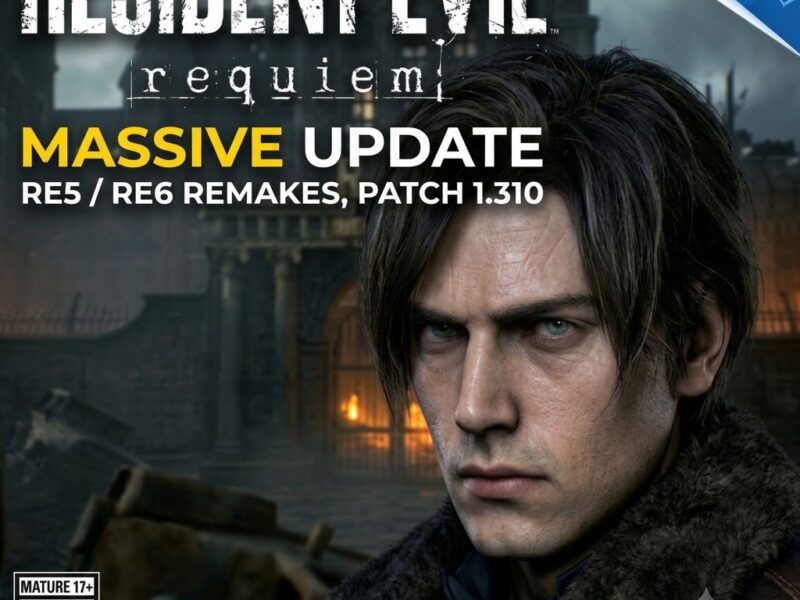
THE RACCOON CITY SYNDROME: Inside Capcom’s $100-Million Lore Rewrite, Leaked RE9 DLC, and the Massive Code: Veronica Gambit
Capcom just accidentally leaked their entire 2027 timeline for Resident Evil, and it completely rewrites 30 years of survival horror history. 🤬🚨
The horror community is in an absolute state of war after a massive internal document from a Capcom Spotlight showcase surfaced online, completely exposing the upcoming Resident Evil Requiem expansion. Dataminers have just pulled hidden narrative files that drop a terrifying bomb about “Zeno,” a legacy character’s dark mutation, and a forced lore connection that legally binds the future Code: Veronica Remake to a massive bio-weapon cover-up. Are they secretly altering the fates of legacy characters just to setup a new live-service universe, or is this the most anxiety-inducing, high-stakes gamble to push the franchise past 1 million wishlists? The truth about what happens to Leon S. Kennedy’s infection changes everything… 👇

The survival horror landscape has just been hit by a thermonuclear information leak. Following the massive critical and commercial triumph of Resident Evil Requiem (officially the ninth mainline entry) earlier this year on PlayStation 5, Xbox Series X/S, and the newly launched Nintendo Switch 2, Capcom appeared to be sitting comfortably on top of the gaming world. The dual-protagonist dynamic of legendary DSO agent Leon S. Kennedy and tactical FBI analyst Grace Ashcroft had successfully rejuvenated the franchise’s traditional roots. But a series of catastrophic internal leaks, database breaches, and technical updates have thrown the community into an absolute frenzy.
Across Reddit’s r/residentevil, X, and major horror gaming communities like GAMERANGE, a massive debate is raging over what insiders are calling the “Grand Unified Resident Evil Timeline.” A series of high-level leaks regarding an unannounced Requiem expansion has inadvertently exposed Capcom’s long-term master plan: a complete, calculated rewriting of the franchise’s foundational lore designed to directly chain past spin-offs into the modern era.
“Capcom isn’t just releasing DLC anymore,” stated a prominent narrative tracker during a deep-dive analysis on X. “They are executing a massive retcon. They are modifying nearly three decades of established history to turn upcoming remakes into mandatory puzzle pieces for the current mainline plot. It’s brilliant corporate synergy, but it is driving old-school purists absolutely insane.”
A closer inspection of the leaked files, patch data from the recent Title Update 1.310, and community milestones reveals that the Resident Evil franchise is stepping into its most ambitious—and highly controversial—era yet.
Part I: The Shadow of Zeno – The Leaked Requiem Expansion
To understand the sudden panic gripping the community, one must look directly at the narrative bombshell contained within the leaked Resident Evil Requiem expansion files. The core game concluded with Grace Ashcroft and Leon Kennedy surviving the biological nightmare of the ARK facility and exposing a global scandal involving the United States government and the remnants of Umbrella’s ultimate bioweapon, “Elpis.”
However, according to newly leaked data, the upcoming narrative DLC is set to introduce a terrifying antagonist known only as Zeno. The datamined script outlines indicate that Zeno is a rogue operative deeply connected to the late Oswell E. Spencer’s hidden cloning experiments.
The leak drops a massive lore bomb: the catastrophic missile strike that leveled Raccoon City in 1998 was not merely an emergency quarantine measure orchestrated by the U.S. military. Instead, the leak suggests the strike was heavily manipulated from behind the scenes by a shadowy syndicate known as “The Connections” to specifically bury the active biological research into the Elpis strain—effectively altering the historical context of the franchise’s most iconic disaster.
This narrative pivot has ignited a fierce ideological war within the fanbase.
“Rewriting the original Raccoon City destruction to make it about a new retconned bioweapon ruins the simplicity of the original trilogy,” argued one user in a massive 5,000-comment thread on Reddit. “It feels like Capcom is making up the lore as they go just to stretch out the storyline.”
A opposing faction quickly pushed back: “The series has always been about corporate and government conspiracies layer upon layer. Tying the Raccoon City incident directly to the biological threats of 2026 makes the universe feel genuinely interconnected and high-stakes again.”
Part II: The Code: Veronica Remake and the 1 Million Wishlist Crucible
While the narrative expansion leaks have caused structural fractures among lore enthusiasts, Capcom’s production pipeline has revealed an even larger tactical gamble. According to leaked schedules from a recent Capcom internal presentation, the Japanese publisher is officially utilizing the Requiem expansion to lay the narrative tracks for the highly anticipated Resident Evil: Code: Veronica Remake, heavily rumored for a late 2027 release window.
Historically, Code: Veronica has been treated by fans as the true “Resident Evil 3” due to its monumental continuation of Claire and Chris Redfield’s fight against the Ashford dynasty. For years, fans have begged Capcom to give the titles the same modern, over-the-shoulder remake treatment afforded to RE2, RE3, and RE4.
By mid-2026, that fan campaign achieved a historic milestone, with Code: Veronica Remake officially crossing 1 million wishlists across digital platforms and local retail trackers before a single frame of gameplay has even been publicly broadcasted.
However, the leaked documents indicate that this will not be a 1:1 faithful recreation of the 2000 classic. To align with the events of Requiem, the remake will reportedly introduce a heavy presence of “civilian horror” elements and extensively restructure the Ashford family’s research to explicitly serve as the direct technological precursor to the modern “Raccoon City Syndrome” virus impacting Leon S. Kennedy in 2026.
By forcing these two eras to merge, Capcom is ensuring that the upcoming Code: Veronica Remake becomes an absolute, unmissable narrative mandatory buy for anyone following the modern storyline, transforming a nostalgic passion project into a corporate financial juggernaut.
Part III: Balancing the “Leon Must Die Forever” Nightmare
While the future of the franchise hangs in the balance, active players are currently wrestling with severe gameplay adjustments deployed in the live client. Capcom recently pushed out Title Update 1.310 (and subsequent hotfix 1.3.1) across all major platforms, explicitly targeting the game’s brutal, highly controversial endgame mode: “Leon Must Die Forever.”
The mode, designed as an ultra-hardcore survival challenge for elite players, had drawn widespread criticism for its artificial difficulty, with player data indicating that over 80% of the active community was failing within the opening two challenge tiers due to hyper-aggressive enemy AI and a severe scarcity of defensive resources.
The new patch notes detail a sweeping mechanical overhaul to alleviate player frustration. The update introduces significant defensive buffs, heavily increasing the trigger probability of the “Explosives Specialist” skill to prevent hand grenades from being consumed upon deployment. Additionally, the “Throwing+” and “Strategist” combat perks received massive power and active-duration boosts, allowing players a fighting chance against crowded rooms of infected mutants.
This swift mechanical intervention highlights Capcom’s modern operational strategy: rapidly monitoring player metrics and adjusting technical mechanics in real-time to preserve high player engagement, ensuring the community remains highly active and primed for the upcoming premium DLC drop.
Part IV: The Transmedia Horizon – Zach Cregger’s Cinematic Shift
The final variable fueling the Resident Evil renaissance of 2026 extends entirely outside the realm of interactive software. Sony Pictures’ PlayStation Productions and Constantin Film are currently entering the final post-production phases for the highly anticipated Resident Evil (2026) cinematic reboot, officially scheduled to hit global IMAX theaters on September 18, 2026.
Directed by acclaimed horror filmmaker Zach Cregger (Barbarian, Weapons) and co-written by Shay Hatten, the $80-million production represents an absolute, hard reboot of the cinematic franchise, completely discarding both the legacy Milla Jovovich era and the critical failures of recent television adaptations.
In a move that mirrors the tactical philosophy of the video game developers, Cregger shocked Hollywood by announcing that the film will feature a completely original perspective, focusing on an unrated, gritty survival story of a simple medical courier named Bryan (played by Austin Abrams) trapped inside Raccoon City concurrently during the events of 1998.
By explicitly choosing not to adapt Leon or Claire’s specific video game narratives, the film avoids direct comparison to the source material while acting as a atmospheric companion piece to the franchise’s global brand. If the film captures the raw, unsettling horror that made Cregger an industry darling, it will trigger an unprecedented cultural wave, feeding millions of casual moviegoers directly back into Capcom’s ecosystem just as the Requiem expansion hits digital storefronts.
Conclusion: The Crucible of the 30th Anniversary
As Resident Evil marches through its milestone 30th anniversary year in 2026, the truth about the franchise is that it is operating at a level of creative and corporate ambition never before seen in the survival horror genre. Capcom has completely discarded the traditional boundary between standalone sequels, transforming Resident Evil into a highly synchronized, multi-generational epic.
The high-stakes gambles being executed behind closed doors—from rewriting historical narrative pillars to forcing mechanical shifts on hardcore endgame modes—prove that Capcom has zero intention of playing it safe. Whether these massive structural overhauls successfully bridge the gap to the 1-million-wishlisted Code: Veronica Remake, or completely alienate the franchise’s foundational fanbase, will be decided in the intense months ahead. The viral samples are locked in the chambers, the corporate blueprints are drawn, and the survival horror evolution is officially underway.