DUST AND DIVINES: Fast Budget Logbook Rotation Shatters Path Of Exile 2’s Endgame Inflation
Are elite players gatekeeping the most consistent, low-barrier resource engine in Path of Exile 2 just to manipulate the crafting market? While the community burns entire fortunes trying to sustain expensive map modifiers in early access patch 0.5, a highly efficient “no-brain” Logbook rotation has surfaced that guarantees steady Divine returns for a fraction of the cost.
We are talking about a lightning-fast speed loop that bypasses standard mapping difficulty entirely, utilizing specialized Master node combinations to force an avalanche of high-tier Expedition artifacts and logbook drops. As the market experiences sudden volatility and top streamers frantically recalculate their hourly liquidation metrics, players are demanding answers to one major question: how long can this low-budget liquidity engine survive before GGG steps in with an emergency balance hotfix? 👇🔥
As early access Patch 0.5 reaches its peak, Path of Exile 2 players find themselves trapped in an increasingly brutal economic landscape. With high-tier mapping strategies requiring massive upfront investments and bleeding-edge character builds, a highly efficient, budget-friendly counter-strategy has quietly taken over the community underground.
Initially documented by prominent economy analysts and specialized content creators using automated Explode Raven Flock setups, this optimized Expedition Logbook Farming Loop allows budget-conscious Exiles to generate massive, stable liquidation pools without ever stepping foot into volatile, hyper-juiced Tier 16 maps.
Bypassing the Map-Juicing Trap
For weeks, the prevailing consensus across official community platforms was that players needed to invest dozens of Divine Orbs into complex Jato or Doryani tablet setups to secure competitive loot returns. This high-barrier meta routinely penalized casual players whose builds couldn’t handle the extreme difficulty spikes associated with stacked endgame rare monster scaling.
The budget Logbook strategy elegantly sidesteps this entire system. Instead of investing currency into maps, players leverage a specific set of Atlas passive nodes and master setups to systematically isolate and extract foundational Expedition currencies, generating clean, unadulterated profit with virtually zero overhead.
THE FAST LOGBOOK ROTATION MATRIX
------------------------------------------------------------
* Primary Master Focus: Jato (For automated instance scaling)
* Target Zone: High-density Expedition remnants and chests
* Core Engine: Fast map clears paired with targeted detonation chains
* Clearing Speed: 2 to 3 minutes flat per logbook region
* Expected Yield: Massive raw artifacts, Gold reserves, and exotic shards
“The beauty of this strategy is that it doesn’t care about your character’s item rarity stats,” commented a market analyst on the PoE 2 subreddit. “You enter a Logbook, execute a specific explosive chain order, sweep the runic monsters, and leave. It’s pure raw economy mechanics at work.”
Deconstructing the Jato Engine
The absolute backbone of this high-yield, low-cost farming rotation lies in a highly calculated combination of Master passives centered heavily on the Jato mechanic. By prioritizing these specific nodes, players are capable of manipulating instance outcomes to favor raw material output:
CRITICAL JATO ATLAS PASSIVE COMBINATION
------------------------------------------------------------
* Unexpected Missions: Guarantees highly efficient master encounter placement.
* Eastern Knowledge: Significantly amplifies the base outcome of Versium Remnants.
* Partial Translation: Introduces a random modifier that heavily scales tablet effectiveness.
* Keen Appraisal: (Optional) Refines item bases dropped within the instance.
By stacking Unexpected Missions alongside Partial Translation, players introduce a massive multiplier to the base efficiency of their maps. When the RNG hits a maximum 40% effectiveness roll across an active layout, the density of runic monster markers and excavated chests increases exponentially. This allows budget players to secure a consistent flow of Logbook drops internally, completely eliminating the need to buy raw farming materials from trade hoarders.
The Art of the Explosive Chain
Unlike standard mapping where players mindlessly blast through monster packs, maximizing a Logbook requires tactical positioning. Top-tier farmers stress that the order of detonation inside an excavation site determines the financial viability of the entire run.
THE OPTIMAL DETONATION PROTOCOL
------------------------------------------------------------
Step 1: Locate and prioritize glowing "Remnants" carrying positive modifiers
        (e.g., "% Increased Quantity of Logbooks" or "% Enhanced Artifact Drops").
Step 2: Place initial explosives to detonate these high-value Remnants FIRST,
        ensuring their multipliers apply to the remainder of the chain.
Step 3: Funnel the subsequent blast radius into high-density clusters of
        "Runic Monster Markers" (indicated by large skulls).
Step 4: Sweep up remaining "Excavated Chest Markers" with residual explosives.
By executing this exact sequence, every single runic monster spawned by the later explosions inherits the massive loot multipliers activated at the very beginning of the chain. This method forcefully scales the drop rates of high-value items, including rare crafting materials, premium unique bases, and highly sought-after Aldur’s Saga items.
High-Speed Liquidation and Market Trends
The final phase of the strategy relies on rapid inventory turnover. Because Logbooks drop an abundant amount of regional gold and vendor-specific artifacts, savvy players aren’t hoarding these materials—they are converting them immediately through automated market listings or direct vendor gambling.
A comprehensive liquidation tracking report from recent speed trials showcases highly stable financial returns:
Continuous drops of raw Exalted and Divine Orbs directly from prioritized runic monster pools.
Hundreds of bulk artifacts translated into high-tier crafting reagents via faction merchants.
A massive, steady accumulation of standard gold, which is directly funneled back into the Kingsmarch black market to gamble for top-tier gear bases like Shavronne’s Satchel or high-end Quarterstaffs.
This sudden influx of foundational materials has introduced a healthy dose of liquidity to the lower tiers of the trade market, allowing mid-game players to comfortably finance their character upgrades without breaking the bank.
Will GGG Drop the Nerf Hammer?
As more players abandon expensive, stressful map-rolling routines in favor of this hyper-consistent budget rotation, discussions are heating up regarding how Grinding Gear Games will handle this grass-roots movement. Historically, the developer favors strategies that reward deep mechanical knowledge and tactical positioning over mindless button mashing.
Because this Logbook rotation relies heavily on precise explosive placement and clever Atlas passives rather than an explicit exploit, many economic veterans believe the strategy is perfectly safe from mid-season interference. For now, the message echoing through the trading hubs of Wraeclast remains completely undisputed: if you want consistent, stress-free wealth in Patch 0.5, stop rolling maps and start blowing up Logbooks.
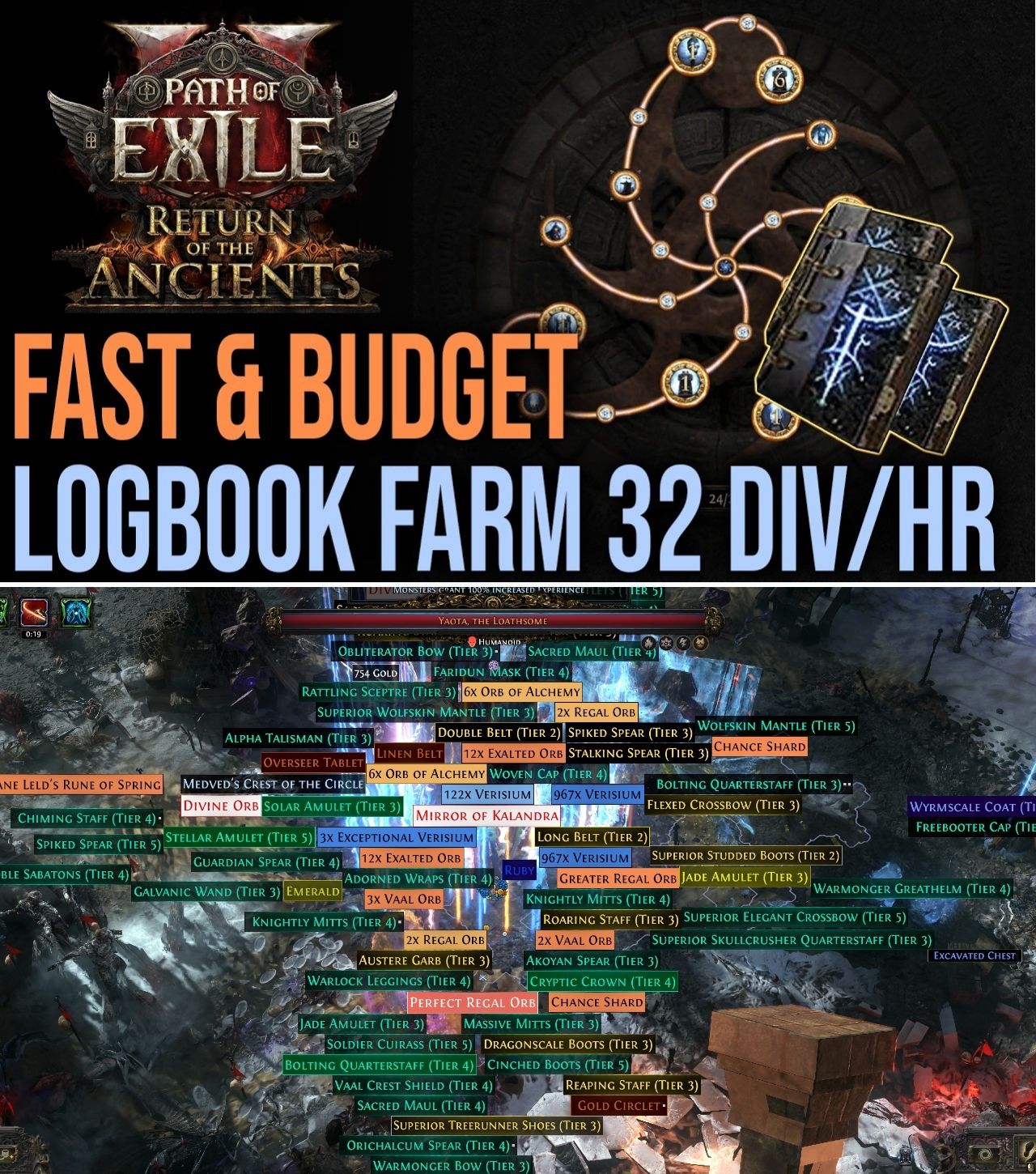
This Expedition Farming Guide Video is highly relevant as it explicitly breaks down the exact Atlas passive nodes, tablet configurations, and active map showcases required to execute this budget Logbook strategy with zero friction.