Why True Crime Sleuths are Rejecting Aussie Suspect’s “Self-Defense” Claim in Thailand
🚨 A LIFE VALUED AT LESS THAN $15? THE KILLER’S LIE UNRAVELED! 🚨
An Australian expat claims he took a teenager’s life in “self-defense” over a petty 500 Baht dispute, alleging she pulled a knife on him. But forensic analysts and internet sleuths are pointing out a glaring, multi-million dollar contradiction in his story that changes everything.
What did the CCTV cameras capture on his arms and neck that completely destroys his “fearing for my life” narrative?
See the damning evidence the suspect didn’t want the world to look closely at 👇 🔥
In the murky underbelly of international crime, some alibis are so brazen they insult the intelligence of the public. Such is the case in the tourist resort city of Pattaya, where 45-year-old Australian national Simon Peter Carman stands accused of the brutal murder of 17-year-old Tunchanok Donhomla, whose naked body was found stuffed inside a black suitcase near a desolate railway track.
Flanked by Royal Thai Police investigators following his dramatic arrest at Bangkok’s Suvarnabhumi Airport, Carman offered a televised apology that has since ignited a firestorm of fury across global social media platforms. His defense? A claim that a dispute over a mere 500 Thai Baht—roughly $14 US dollars—escalated until the teenage girl allegedly pulled a kitchen knife on him, forcing him to act in “self-defense.”
But as true-crime communities on X (formerly Twitter), Reddit, and TikTok dissect the forensic evidence and the suspect’s financial profile, the “panicked self-defense” narrative is rapidly crumbling. What is emerging instead, according to online sleuths and behavioral experts, is a chillingly asymmetric tale of a calculated predator attempting to use a classic legal loophole to escape the executioner.
The Anatomy of an Audacious Alibi
To understand why the internet has universally rejected Carman’s defense, one must look at the sheer financial absurdity of the claim. According to local media leaks, Carman had been living a comfortable expat lifestyle in Pattaya for approximately eight months, renting a high-end apartment and maintaining significant disposable income. Furthermore, when his crime was discovered, he was able to instantly purchase a premium, last-minute ticket on a Jetstar flight to Perth, Australia—a transaction costing hundreds of dollars.
“The math simply doesn’t check out,” noted a viral thread on Reddit’s r/TrueCrime Discussion that has amassed over 5,000 upvotes. “We are expected to believe that a man who has thousands of dollars at his disposal for international travel, long-term rentals, and nightlife suddenly suffered a homicidal break over a $14 service dispute? It is a nonsensical motive designed to trivialize the victim and deflect blame.”
On X, users are calling the 500 Baht claim a “cheap legal tactic.” In Thailand, a murder committed during a sudden, uncontrollable argument (often referred to as a “heat of passion” offense) or an act of excessive self-defense carries significantly lighter penalties than premeditated murder. By framing the tragedy as a financial dispute initiated by a knife-wielding teenager, Carman is allegedly attempting to downgrade his charges from Section 289 (premeditated murder, which carries a mandatory death sentence) to a lesser manslaughter charge.
What the CCTV and Forensics Really Show
The most damning refutation of Carman’s “fearing for my life” defense comes from the physical evidence captured by Pattaya police forensic teams and external security cameras.
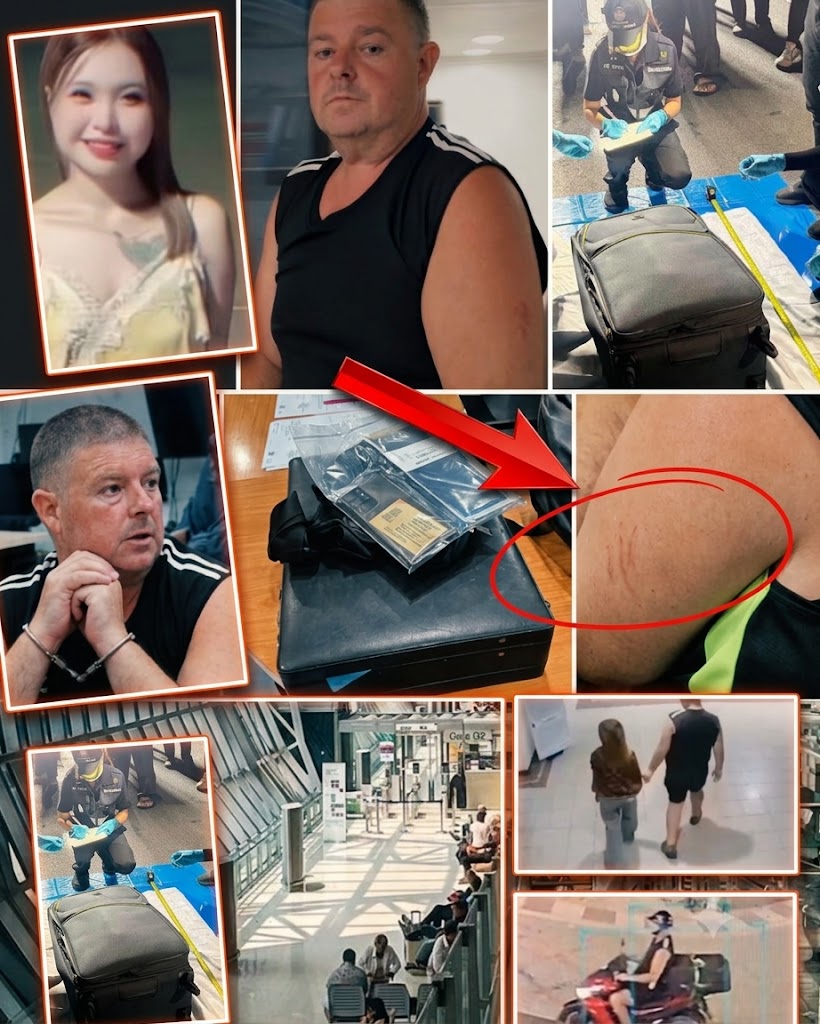
When Carman was intercepted at the airport departure gate, news cameras captured deep, raw, parallel scratches scoring his neck, chest, and arms. In his televised statement, Carman implied these were injuries sustained while disarming the 17-year-old victim. However, forensic enthusiasts on TikTok and Discord have pointed out a stark medical contradiction.
“Knife defense wounds look entirely different,” explained a forensic nurse in a TikTok video that has garnered over 800,000 views. “If someone is attacking you with a kitchen knife, you suffer deep, defensive lacerations across the palms of your hands, your fingers, and the outsides of your forearms as you try to block the blade. The long, deep vertical scratches on Carman’s neck and chest are textbook marks of human fingernails. Those are survival scratches. That is what happens when someone is being choked to death and desperately tries to pull the killer’s hands off their throat.”
Furthermore, the condition of the crime scene inside Carman’s luxury apartment tells a story of systematic execution rather than a chaotic knife fight. Investigators reportedly found no signs of overturned heavy furniture, shattered glass, or blood splatter patterns consistent with a wild blade assault. Instead, the evidence points to a swift, overwhelming application of blunt force and strangulation directed at a victim who weighed barely 45 kilograms.
Victim-Blaming in the Digital Age
The outrage vibrating through Discord servers dedicated to Thailand true crime is fueled by what many describe as a malicious case of posthumous victim-blaming. Because Tunchanok Donhomla cannot speak from the grave, Carman’s narrative relies on painting the 17-year-old small-town girl from Kalasin as a dangerous, volatile extortionist.
“It’s the oldest trick in the predator’s handbook,” wrote a prominent user on a Southeast Asian expat forum. “You kill a vulnerable, underage local girl, hide her body like garbage, and when you get caught at the airport, you claim she was the aggressor who tried to rob you. It relies on deep-seated biases against young women working in tourist hubs.”
CCTV footage from the night of the murder heavily contradicts the image of a hostile dispute. At 3:30 AM on Thursday, June 25, the apartment’s lobby camera recorded Cake and Carman walking in together. They were holding hands. Cake appeared relaxed, showing zero signs of tension or hostility.
Eighteen hours later, Carman was seen on the same camera, calmly walking out alone, carrying a massive black suitcase. He did not call an ambulance. He did not alert the building’s security that he had been attacked by a knife-wielding woman. Instead, he systematically strapped the suitcase to a motorbike, dumped it in a marshy area near the railroad tracks, and went back to clean his room.
“A man who kills in genuine self-defense calls the police immediately,” argued a criminal psychologist during a YouTube breakdown of the case. “A man who spends 18 hours packing a teenager into a suitcase and scouting a body-dumping site is operating with cold, calculated intent. The 500 Baht story is an afterthought created to save his own skin.”
The Grief of Kalasin and Demands for Execution
While the international community debates the mechanics of the crime online, the real-world devastation is concentrated in the rural province of Kalasin. Cake had moved to Pattaya just two weeks prior, hoping to find employment to send money back to her impoverished family. Her father and stepmother, who collapsed in tears upon arriving at the police station to identify her remains, have publicly begged the Thai judiciary not to fall for the suspect’s lies.
“My daughter was a child,” her father told reporters through a veil of tears. “She was small, she was gentle. She could never threaten a grown Western man with a knife. He is lying to save himself from the needle. We want him to face the death penalty. Nothing less.”
The family’s stance has been fiercely supported by Thai netizens, who are demanding that the Royal Thai Police treat the case with absolute severity, regardless of the suspect’s foreign passport.
The Legal Outlook: Breaking the Defense
The Pattaya Provincial Prosecutor’s office appears entirely unswayed by Carman’s 500 Baht self-defense claim. They have officially tống đạt (served) the suspect with three heavy charges: premeditated murder, concealing or destroying a corpse, and statutory offenses involving a minor.
Under Thai legal precedent, the prosecution can easily dismantle a self-defense claim by highlighting the suspect’s behavior after the fact. The act of hiding the body, fleeing the scene of the crime, lying to the victim’s friends via text, and attempting to leave the country are legally recognized as “indices of guilt.” A legitimate act of self-defense vanishes the moment a suspect treats a human body as contraband.
As Simon Peter Carman begins his mandatory 84-day pre-trial detention at the Pattaya Provincial Prison—denied bail due to being an extreme flight risk—his high-stakes gamble is failing. The internet has seen through the 500 Baht smoke screen, and the forensic trail left in Room 404 is pointing toward a grim, final verdict.