The Chilling Mystery of the Final LINE Text in Pattaya Suitcase Murder
⚠️ THE LINE MESSAGE SENT FROM BEYOND? ⚠️
Hours before a 17-year-old girl’s body was found stuffed in a suitcase in Pattaya, her friends received a text saying she was “perfectly safe” with her 45-year-old Australian companion. But cyber detectives just uncovered a chilling timeline anomaly that points to an unthinkable horror.
Who was really holding the phone when that final message was sent, and what did the suspect desperately try to cover up before rushing to the airport?
The terrifying truth behind the digital smoke screen exposed here 👇 🔥
It is a digital ghost story that has sent a shiver through the international true-crime community and ignited a firestorm across social media. On the afternoon of Thursday, June 25, 2026, a routine text notification pinged on a mobile phone in Thailand’s rural Kalasin province. It was a message from 17-year-old Tunchanok Donhomla, affectionately known to her family and friends as “Cake.” The text reassurance was simple, brief, and meant to give comfort: she was in Pattaya, she was with her 45-year-old Australian companion, Simon Peter Carman, and she was “perfectly safe.”
Less than thirty-six hours later, Cake’s naked, heavily bruised body was discovered crammed inside a large black suitcase, abandoned in a desolate patch of weeds next to a railway line four kilometers away from Carman’s luxury rented apartment.
As Royal Thai Police investigators piece together a horrific timeline of violence, digital sleuths on X (formerly Twitter), TikTok, and Reddit have locked onto a disturbing anomaly that threatens to blow the suspect’s defense completely out of the water. The central, haunting question driving millions of views online is simple: Who was actually holding the phone when that final LINE message was sent?
The 18-Hour Timeline of Horror
To understand the intense speculation gripping platforms like Reddit’s r/TrueCrime and r/ThailandExpat, one must look at the cold, hard numbers captured by closed-circuit television (CCTV).
According to Pattaya police logs leaked to local media, Cake and Simon Peter Carman were captured on security footage walking hand-in-hand into Carman’s apartment building at precisely 3:30 AM on Thursday, June 25. The young girl, who had only arrived in the resort city a week prior from her northeastern home province, looked calm. It would be the last time she was ever seen alive.
For the next eighteen hours, the apartment remained a black box. No one entered; no one left.
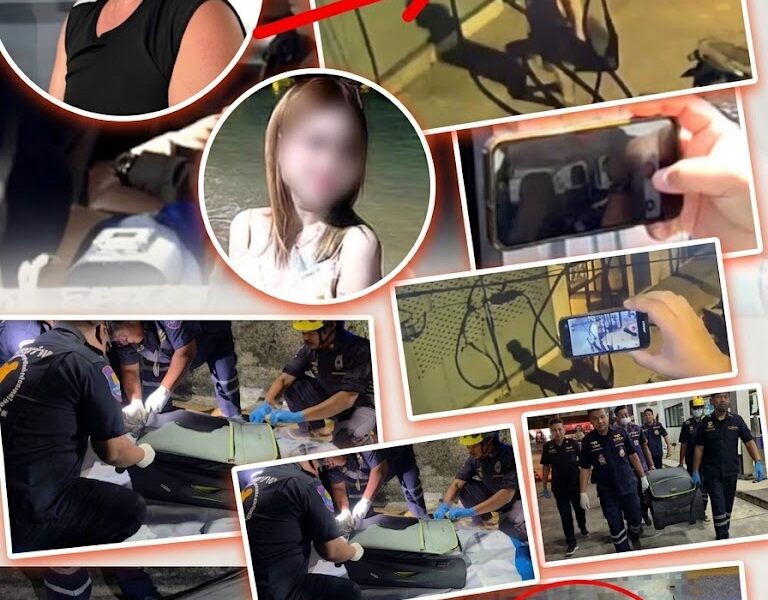
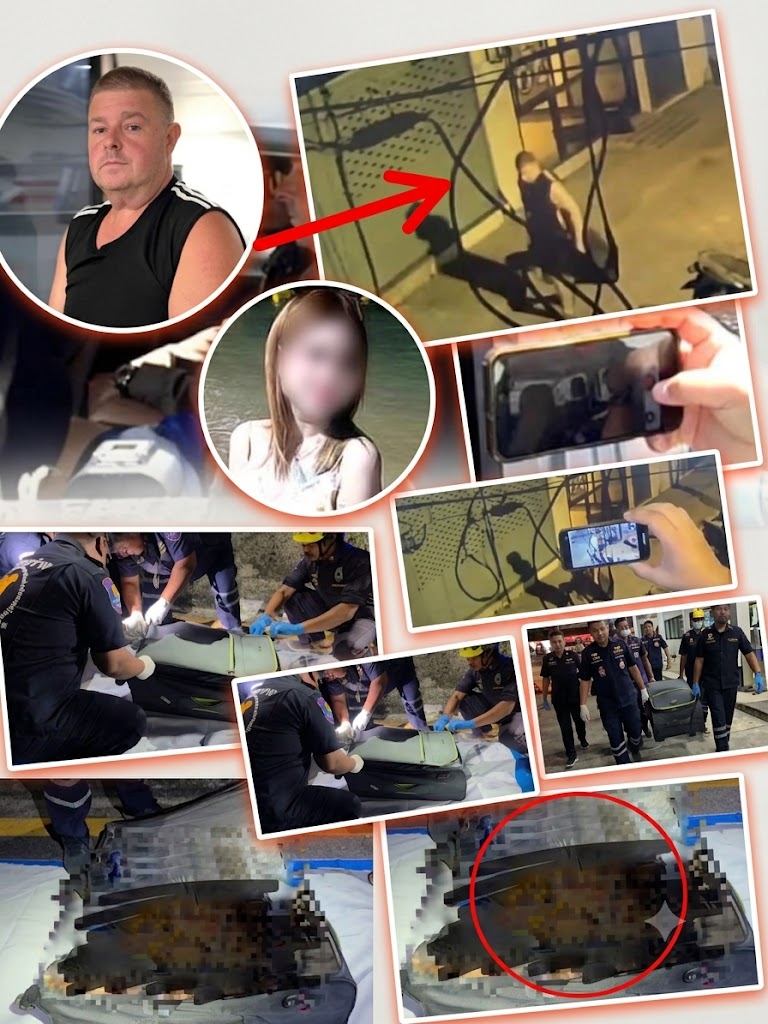
Then, at approximately 9:30 PM that same evening, the external CCTV cameras flashed to life again. The footage, which has since gone viral on TikTok with millions of views, shows Carman emerging from the building alone. He is seen struggling heavily with a massive, bulging black suitcase. With chilling methodical precision, he straps the oversized luggage to the back of a rented motorbike, drives off into the dark, and returns forty-five minutes later—without the suitcase.
The digital anomaly lies squarely within that 18-hour dark zone. According to community moderators tracking the case on a dedicated Discord server, the reassuring LINE message was sent to Cake’s close friend at approximately 2:15 PM—nearly eleven hours after she entered the room, but seven hours before Carman rolled the suitcase out of the lobby.
The TikTok Forensics: A Digital Smoke Screen?
On TikTok, true-crime creators and self-proclaimed OSINT (Open Source Intelligence) analysts have been dissecting the linguistic style and timestamp of that final message. The prevailing theory dominating the platform suggests that Cake was already dead when the text was transmitted.
“Look at the phrasing,” noted one viral TikTok video that has amassed over 1.2 million views. “Friends claim Cake rarely used formal punctuation or specific Thai reassurance particles when texting her inner circle. The message sent at 2:15 PM was uncharacteristically structured. It read like someone trying too hard to project an aura of normalcy.”
The digital smoke screen theory posits a sinister sequence of events: Carman allegedly committed the murder in the early morning hours following a violent altercation. Realizing that the 17-year-old’s friends or family might grow suspicious if she uncharacteristically vanished from social media, the suspect allegedly accessed her phone, unlocked it using her biometric data or a known PIN, and fabricated the alibi text to buy himself time.
If true, the maneuver worked—temporarily. The reassurance message delayed any immediate panic among Cake’s friends, giving Carman an 18-hour window to allegedly scrub the crime scene, conceal the body, scout a disposal location by the railway tracks, and book an emergency, high-priced Jetstar flight out of Bangkok’s Suvarnabhumi Airport bound for Perth, Australia.
The Suspect’s Defense vs. Cyber Reality
When Carman was intercepted by border police at the departure gate on Friday night, his body bore the telltale signs of a desperate struggle—deep, jagged scratches ran down his neck and arms. Under interrogation, the Ballarat native confessed to causing her death but fiercely rejected the premeditated murder charge, claiming “self-defense” during a frantic dispute over a 500 Baht ($14 USD) service fee.
“She pulled a knife on me,” Carman muttered in a televised clip broadcast by Thai media, his eyes downcast as he offered a highly controversial public apology. “I panicked. It got out of hand. I’m sorry.”
However, the “panic” narrative is being fiercely contested on Reddit. Users on the r/TrueCrimeDiscussion subreddit point out that a man experiencing a blind, panicked adrenaline rush does not logically pause to send calculated, calm texts from his victim’s phone to throw off the police.
“The timeline completely invalidates his panic defense,” wrote a prominent Reddit investigator in a thread that has garnered thousands of upvotes. “If he killed her in the morning, held her phone at noon to text her friends that she was ‘safe,’ and then waited until nightfall to dump the body, that isn’t panic. That is a highly organized, cold-blooded cover-up. It proves premeditation and awareness of guilt.”
Thai cyber-crime units are currently conducting a forensic extraction of both Cake’s and Carman’s mobile devices. Investigators are reportedly analyzing cellular tower pings and typing-cadence biometrics to determine if the phone’s movement and typing style at 2:15 PM matched Cake’s historical data or if it synchronized perfectly with Carman’s device location inside the room.
A Community in Rage and Mourning
While the digital warfare over timestamps and cyber forensics rages on X, the human cost of the tragedy has left Pattaya in a state of somber reflection. On Discord servers dedicated to Pattaya expats, the tone has shifted from shock to deep anger.
Many point out the devastating vulnerability of young girls migrating from impoverished provinces like Kalasin to the high-stakes, neon-lit tourist hubs of the coast. Cake was only 17, a minor whose life was violently snuffed out in a foreign-rented apartment, her memory now reduced to a grim digital puzzle.
The victim’s family, who traveled to Bangkok in an absolute state of emotional collapse to claim her remains, have corporate-level clarity on what they want. Speaking through a translator to international reporters, Cake’s father demanded the absolute maximum penalty under Thai law: execution.
“He stole my daughter’s future and treated her like trash,” the grieving father sobbed. “He tried to trick her friends. He tried to fly away to his own country. He deserves no mercy.”
The Legal Road Ahead
Under Section 289 of the Thai Penal Code, premeditated murder carries a mandatory sentence of death. While capital punishment is rarely carried out on Western passport holders—often commuted to life imprisonment after lengthy appeals—the digital evidence of the LINE message could become the prosecution’s ultimate weapon.
If the Royal Thai Police forensic team can definitively prove that Carman sent that text message from Cake’s phone post-mortem, it completely dismantles any legal argument for manslaughter or “heat-of-passion” self-defense. It transforms the case from a tragic, out-of-control argument into a calculated, predatory execution and subsequent cover-up.
As Simon Peter Carman sits behind bars without bail at the Pattaya Provincial Prison, the clock is ticking. Thai prosecutors have a maximum of 84 days to formalize their brief and present the digital and physical evidence to the court. Until then, the world watches the digital trail left behind in Room 404, waiting to see if a simple text message sent from a dead girl’s phone will ultimately seal her killer’s fate.