The hangar at Joint Special Operations Command wasn’t built for comfort. Concrete floor. Steel rafters. Four hundred operators standing shoulder to shoulder, arms folded, eyes sharp—the kind of crowd that measured credibility in scars, not words.
At the center mat stood Elena Cross—5’2”, compact, unreadable. Plain gray shirt. No rank on display. No hype. Just a stopwatch on a crate and three colonels watching like bouncers at the door.
Colonel Marcus Shaw broke the quiet. “You’re here to certify as a close-quarters instructor,” he said. “No theatrics. Control only. You’ll be engaged. You’ll respond.”
Elena nodded once. “Yes, sir.”
From the back came a low chuckle. A senior cadre member—Tom “Grinder” Hale—leaned to his buddy. “Control’s hard when you’re outmatched,” he said, not bothering to whisper.
Elena didn’t look his way. She adjusted her feet.
Shaw pointed to the mat. “Two evaluators. Non-lethal. Begin.”
The crowd shifted. This was supposed to be routine—pressure, posture, clean technique. A teaching moment.
The first evaluator closed fast, hand reaching for Elena’s shoulder. The second circled, fishing for an arm.
Then the script broke.
The lead evaluator lunged high—fingers snapping toward her throat. An illegal grab. Dominance, not testing. The second surged in behind, locking to smother her base.
A beat of anticipation rippled through the hangar.
Elena moved.
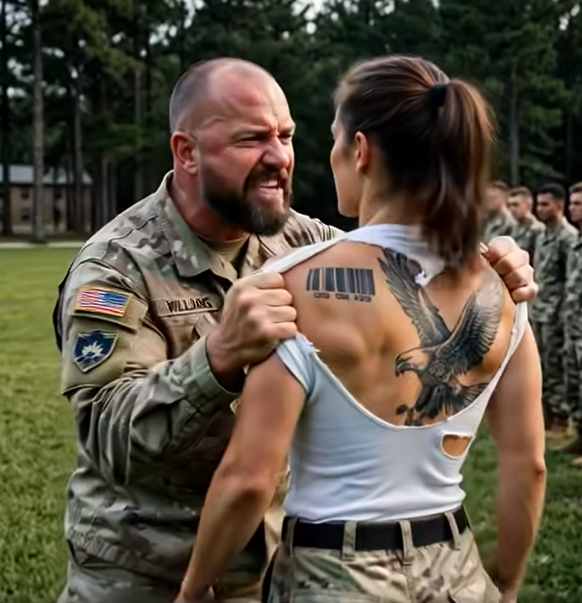
She dipped her chin, jammed the wrist against her collarbone, and stepped through the attack—hip slicing under his center like a hinge. His forward drive became torque. She turned, dropped, and folded him to the mat with a pin so precise his breath left in a sharp, surprised bark.
The second evaluator tightened.
Too late.
Elena’s heel kissed his ankle, her shoulder rotated, and gravity did the rest. He landed clean—flat, controlled, helpless.
No scramble. No strain.
Four seconds.
Both men down. Both contained.
The hangar went dead quiet.
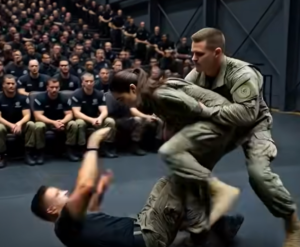
Elena held the pin, eyes up, breathing even—textbook dominance without a shred of showmanship. Then she released, stepped back, and waited.
Colonel Shaw stared, recalculating. Grinder Hale’s grin was gone.
“If you go for the neck,” Elena said calmly, voice carrying, “you’ve chosen escalation. I finish it before it spreads.”
No one laughed.
Before Shaw could speak, an operations aide hurried in, color drained from his face. He leaned in, whispering hard.
Shaw’s jaw tightened. He looked at Elena like he was seeing her for the first time.
“Your clearance,” he said slowly, “just flagged an active inquiry—Defense Intelligence Oversight. Effective immediately.”
Elena didn’t blink.
She already knew.
Because some skills aren’t learned in classrooms—and some files are buried for a reason.
The hangar remained frozen for a long five-count after Elena released the second evaluator. The two men stayed down—not because they were injured, but because something in the air told them moving would be unwise. Every operator in the room had just watched technique so clean it looked effortless, and effortless technique from someone that size meant training most of them had never touched.
Colonel Shaw finally cleared his throat. “Stand down,” he ordered, though the words felt redundant. The evaluators rolled to their knees, then stood. Neither looked at Elena. They kept their eyes on the concrete.
Shaw turned toward her. “You anticipated the escalation.”
“I train for what people actually do, sir, not what the manual says they should do.”
Another ripple of low murmurs. This time no one laughed.
Shaw glanced at the aide who had delivered the message. The young captain’s face was still pale; he held a folded printout like it might bite him. Shaw took it, scanned the single page, then looked back at Elena.
“Defense Intelligence Oversight,” he repeated, louder this time so the room could hear. “They want you in D.C. tonight. Black-bag escort waiting outside.”
A few operators exchanged glances. Black-bag escort meant no commercial flight, no paper trail, no questions. It meant someone upstairs had just lit a flare.
Elena gave the smallest nod. “Understood.”
Shaw studied her another moment—the same calm that had carried her through the two-on-one takedown. “You knew this was coming.”
“I knew it was possible.”
He exhaled through his nose. “Then why demonstrate at all? You could have phoned in the cert.”
“Because the job matters, sir. And because the people in this room need to remember what real control looks like when the rules stop applying.”
Silence again. This time it carried weight.
Shaw folded the paper and tucked it inside his blouse. “You’re dismissed. They’ll meet you at the east gate.”
Elena stepped off the mat, collected the stopwatch from the crate, and walked toward the hangar doors. No one moved to stop her. No one spoke. Four hundred sets of eyes followed the small figure in the plain gray shirt until she disappeared through the personnel exit.
Outside, a matte-black Suburban waited, engine already running. Two men in plain clothes stood beside it—neither smiled, neither offered a hand. Elena climbed into the back seat without a word. The door closed with a soft, final click.
The vehicle pulled away, tires crunching over gravel, then asphalt, then the long ribbon of highway that led toward Andrews Air Force Base.
Inside the hangar, Grinder Hale finally found his voice.
“She’s not an instructor,” he said quietly. “She’s something else.”
Shaw didn’t answer right away. He watched the empty doorway a moment longer, then turned to the room.
“Class dismissed,” he said. “And the next time any of you think size decides dominance, remember today.”
The operators filed out in near silence. No trash talk. No bravado. Just the sound of boots on concrete and the faint echo of a truth none of them had expected to learn.
Washington, D.C. – 0330 hours
The unmarked room had no windows and smelled faintly of old coffee and ozone. Elena sat alone at a steel table. Across from her were three people she recognized from clearance briefings she was never supposed to remember: a two-star from DIA, a sharply dressed woman from the National Security Council, and a civilian attorney whose badge read “Office of General Counsel – Special Access Programs.”
The general spoke first. “You understand why you’re here.”
“Yes, sir.”
“You executed an unsanctioned field demonstration against two cleared evaluators. One of them filed an injury claim. The paperwork crossed my desk at 2200 tonight.”
Elena kept her face neutral. “They escalated. I de-escalated. Within established ROE for force-on-force training.”
The NSC woman leaned forward. “You dislocated the lead evaluator’s shoulder in four seconds. That’s not de-escalation. That’s surgical.”
“It’s what happens when someone reaches for the throat instead of the training script.”
The attorney cleared his throat. “The claim has been withdrawn. The evaluators have been reminded of the non-disclosure agreements they signed. Officially, the incident never occurred.”
Elena waited. There was always more.
“But unofficially,” the general continued, “we have a problem. A foreign intelligence service has acquired partial biometric data from a joint exercise three years ago. The signature matches yours. They believe the operator is still active. They’ve already tried to burn you twice—once in Amman, once in Tbilisi.”
Elena’s expression did not change. “They’re late. I retired that signature in 2023.”
“Not according to the chatter we’re seeing,” the woman said. “They think you’re still running deniable ops for JSOC. And they’re willing to pay very large sums to anyone who can confirm the location of the 5’2” ghost who leaves no fingerprints.”
The room went quiet.
The general slid a single photograph across the table. A grainy still from a street camera in Baku—Elena’s profile, three years younger, hair shorter, eyes locked on something off-frame. A red circle had been drawn around her left ear. Someone had already started shopping the image.
“We can bury this,” he said. “New legend, new prints, new life. You disappear again—permanently this time. Or…”
He let the word hang.
Elena looked at the photo for a long moment, then pushed it back across the table.
“Or I stop hiding,” she finished.
The three officials exchanged glances.
The attorney spoke carefully. “If you surface publicly, the risk multiplies exponentially. Every hostile service will know exactly where to look.”
“I’m aware.”
The general leaned back. “Then why?”
Elena met his eyes. “Because the next time someone in a hangar laughs at the small evaluator, I want them to remember there’s a reason she’s still breathing. And I want them to know she’s not the only one.”
Silence stretched.
Finally the NSC woman nodded once. “We’ll need a cover story for the sudden retirement. Medical, most likely. Stress injury from training.”
“Fine.”
“And you’ll sign a lifetime NDA with criminal penalties.”
“I already did.”
The general stood. “Then we’re done here. You’ll be on a flight to CONUS at 0600. Civilian ID waiting at Andrews. After that… you’re a ghost again. Officially.”
Elena rose. “One request.”
They waited.
“Tell the evaluators I’m sorry about the shoulder. Tell them it wasn’t personal.”
The general almost smiled. “I’ll pass it along.”
She walked to the door, paused, then looked back.
“Sir?”
“Yes?”
“If they ever try to burn me again… don’t bury the file. Let them find it.”
The general studied her for a long second.
Then he nodded once.
Elena stepped into the corridor. The door closed behind her with a soft hydraulic sigh.
Outside, the first gray light of dawn was bleeding across the Potomac. Somewhere in the city, operators were waking up to a new rumor: the 5’2” ghost who dropped two men in four seconds wasn’t coming back to teach.
She was going home.
And she was done hiding.
News
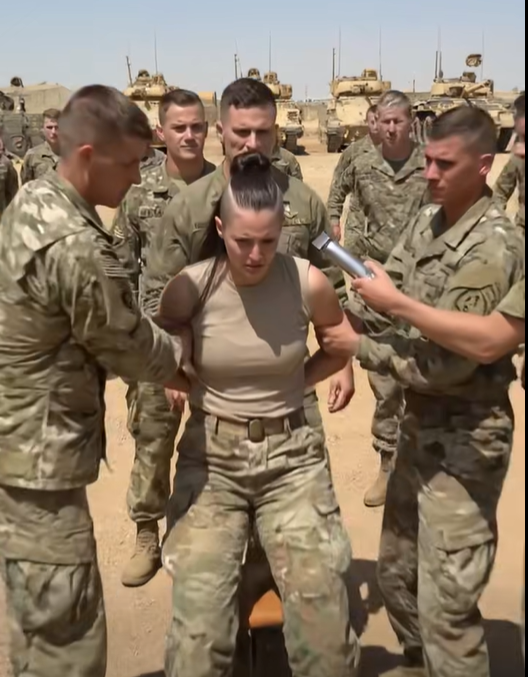
“Shave Her Head,” the Sergeant Ordered Coldly. “If Discipline Won’t Break Her, Maybe Humiliation Will.” But What They Didn’t Know Was That the Woman They Underestimated Would Bring Their Entire Base to Its Knees.
General Alexander Vance had heard the whispers for months: Fort Blackwood was rotting from within. Soldiers spoke in hushed tones of systematic humiliation disguised as “discipline,” falsified training records, missing supply funds that somehow vanished into private accounts, and a toxic command climate built on fear and intimidation. Every official inspection came back sparkling clean […]
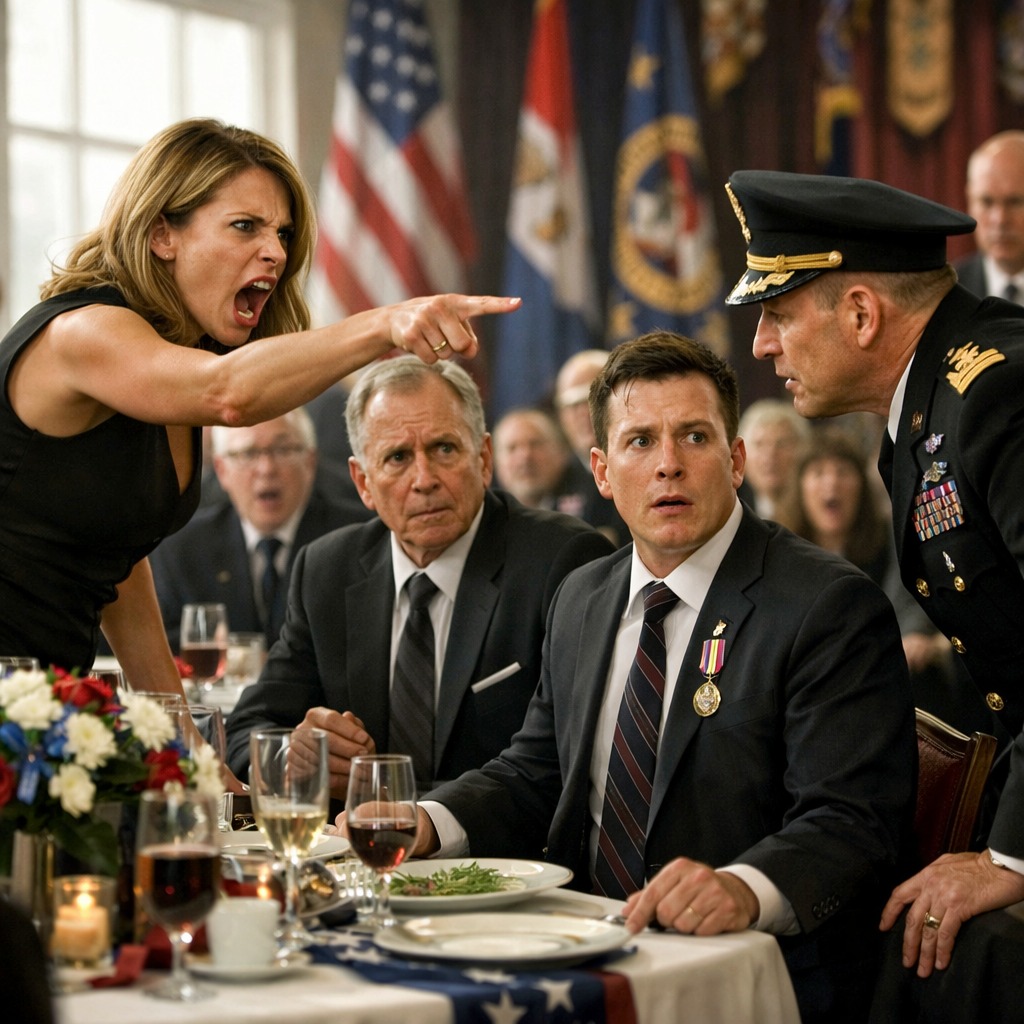
At A Veterans’ Dinner, The Colonel Leaned Toward My Brother And Asked One Simple Question: “Can You Tell Me How You Earned This Decoration, Son?” His Face Turned White. He Pointed At My Father And Said: “He Told Me It Belonged To Our Uncle.” The Uncle Never Existed.
The Ridgewood Armory smelled like every other veterans’ event I’d ever attended: floor wax, overcooked chicken, old coffee, and the faint metallic tang of too many American flags. Fluorescent lights buzzed overhead, casting a harsh glow on rows of folding tables and men in ill-fitting blazers trying to look like they still belonged in uniform. […]
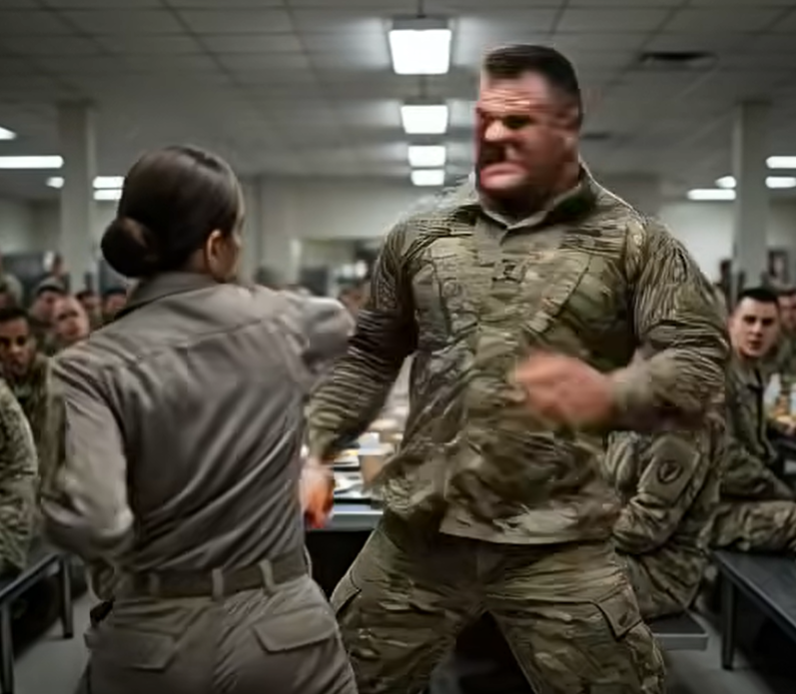
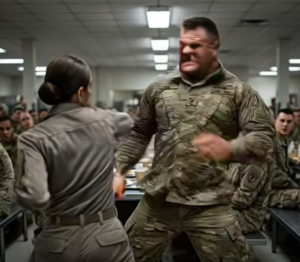
“Die, B*tch,” He Spat, Swinging a Massive Fist in the Mess Hall. He Thought I Was an Easy Target — He Had No Idea He Just Attacked a Classified SEAL Shadow Operative.
I was running on fumes. Seventy-two hours of off-the-books reconnaissance in the frozen Alaskan wilderness had left every muscle screaming. My joints ached from crawling through ice-crusted snow, my eyes burned from staring through night-vision gear, and the only thing keeping me upright was the promise of a hot meal and twelve hours of blackout […]
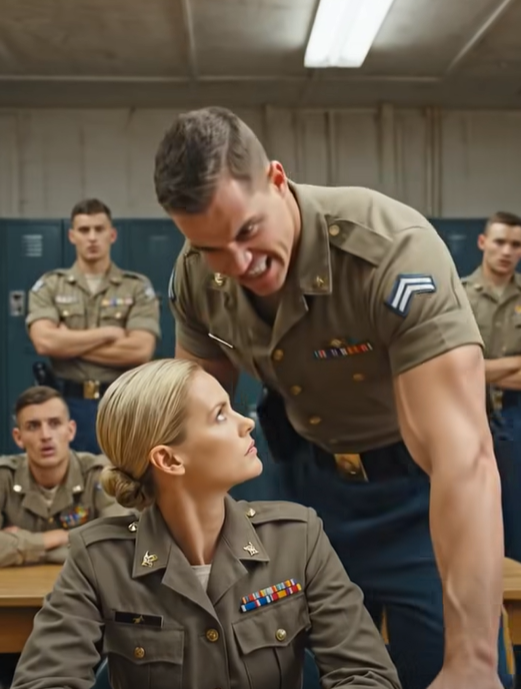
“Do You Know Who I Am?” He Pushed Her — Seconds Later, One ID Card Ended His Career
The dim lights of Rusty’s Bar flickered like dying stars just outside Camp Pendleton. It was a Friday night, the kind where Marines came to forget the sand and the screams they carried home from deployment. I had come here for the opposite reason — to disappear. My name is Commander Thalia Renwick. Highly decorated […]
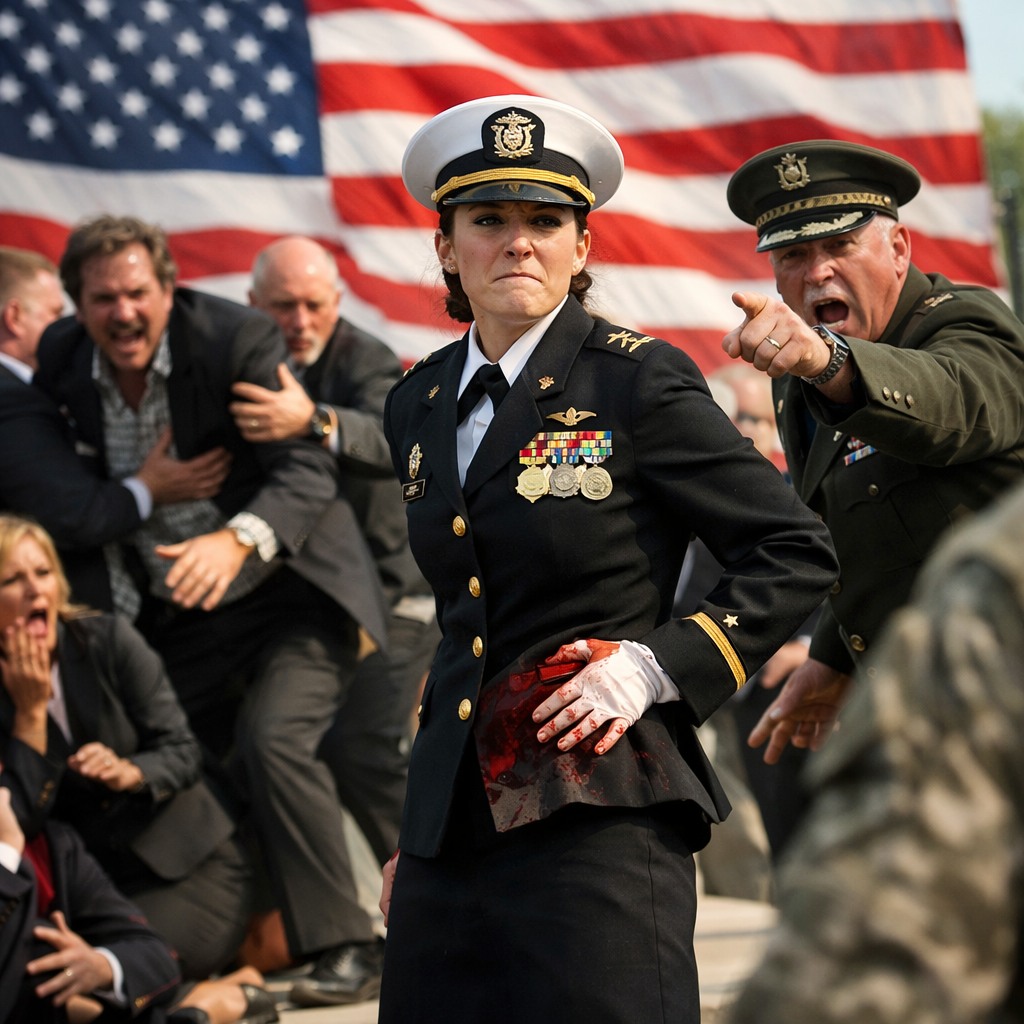
15 Years After My Dad Kicked Me Out, I Saw Him At My Sister’s Wedding. He Sneered: “If It Wasn’t For Pity, No One Would’ve Invited You.” I Just Smiled And Sipped My Wine. Then The Bride Took The Mic And Changed Everything.
The South Carolina sun was merciless that June afternoon, turning the outdoor wedding venue into a glittering oven. I stood near the back in my crisp Army dress uniform, the brass buttons and medals catching the light with every breath. At 34 years old, I had come home for my little sister’s wedding — the […]
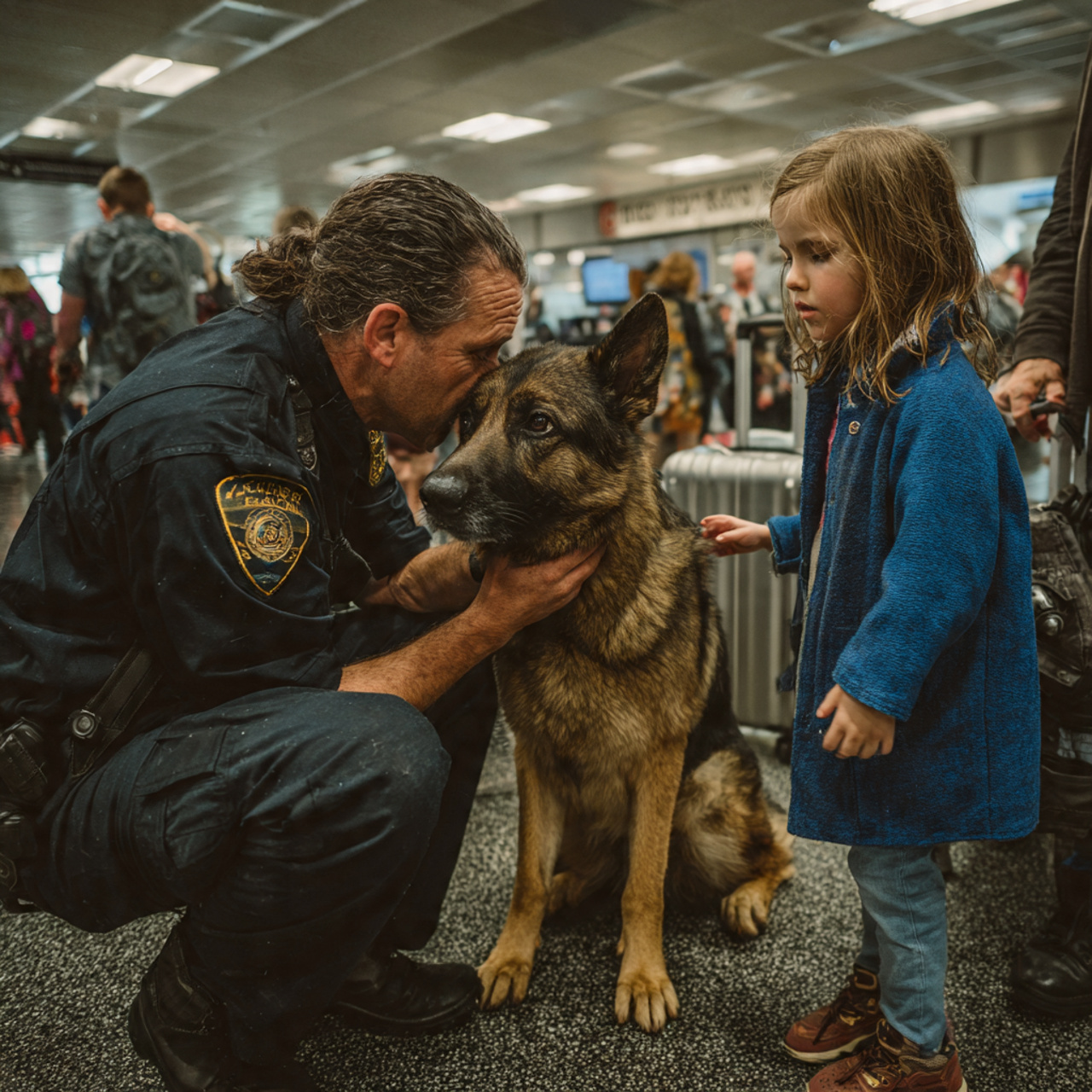
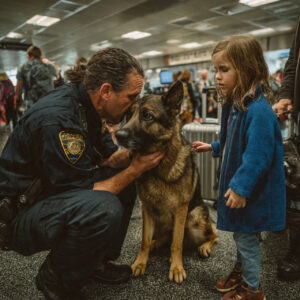
“A POLICE DOG FROZE IN THE AIRPORT. THEN A LITTLE GIRL TAPPED HIS HEAD. WHAT HAPPENED NEXT MADE EVERY TRAVELER STOP. HAVE YOU EVER WITNESSED A SILENT CRY FOR HELP?
The bustling international airport was a whirlwind of rolling suitcases, hurried announcements, and weary travelers rushing to their gates. Officer Liam Mercer patrolled the terminal with his loyal K9 partner, Rex — a highly trained German Shepherd known for his sharp instincts in detection and child safety operations. Everything seemed routine until Rex suddenly froze […]
End of content
No more pages to load