They Threw Her in the Ocean — Then Found Out Navy SEALs Own the Water
The night sea looked like black glass, smooth enough to fool someone who’d never had to read it for danger. On the steel deck of the freighter, though, Elise Ward could feel the truth through her knees. The hull rolled in a slow, patient rhythm. Diesel heat rose from vents under the grating. Somewhere below, chains clinked. Somewhere above, a floodlight buzzed. And somewhere behind her, men decided she was done.
Elise knelt with her hands zip-tied behind her back and her ankles chained to a cinder block wet with algae. Her bare feet slid on the grime as the ship’s motion shifted. One boot lay ten feet away, torn off during the fight. The other had vanished entirely. Her cheek throbbed. Her left eye was swollen nearly shut. Salt crusted her lips like she’d been chewing sand.
Two days. That’s how long they’d worked on her.
Not a clean interrogation. Nothing official. Just contract men with cheap gloves and expensive confidence, asking questions like they owned the ocean.
Routes. Schedules. Keys. Who else knew about the shipment. Who had eyes on the manifests. What satellites had caught. What the Navy suspected.
Elise gave them nothing.
She hadn’t even given them the satisfaction of hearing her voice shake.
When questions failed, they switched to pain like it was a language they trusted more. Water poured over her face inside a storage container, a cloth pressed tight until her body tried to inhale the sea. Stress positions that made her shoulders feel like they were being pried apart. Sleep deprivation with engine noise screaming inches from her skull. Cold air blasted at her while they laughed and ate and took turns watching her fade.
She didn’t fade.
The men grew irritated by her refusal to become what they needed: a frightened intel officer willing to trade secrets for breath. They had expected a different kind of captive.
Elise wasn’t that kind.
The smoker stood near the rail now, cigarette ember glowing like a tiny warning light. He exhaled sideways, smoke torn away by wind. “Buzzards don’t circle water,” he muttered in an accent that didn’t belong to any navy. “No one’s coming.”
Another man—short hair, tactical vest, skin like old leather—crouched beside Elise and gripped her jaw hard enough to make her teeth click. He forced her face toward the floodlight, inspecting her like she was cargo.
“Any tracker?” he asked, not to her, but to the third man.
The third man didn’t talk much. He was the type who saved words for contracts and saved violence for everything else. He glanced at Elise’s torn wetsuit liner, the bruises, the blood smeared on her temple.
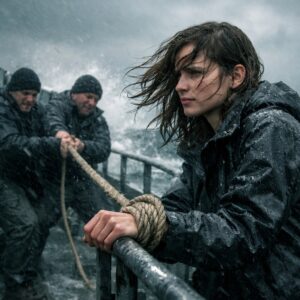
“She’s clean,” he said.
Elise didn’t react. Not because she couldn’t. Because reacting wasted energy, and energy was oxygen.
They hadn’t checked properly. They never did when they thought they had already won.
Behind Elise’s knee, sewn into a seam that looked like reinforcement, was a small rigid bump. Not comfort. Not padding. A ceramic blade, waterproof, nearly invisible. Not a primary tool. A backup. The kind you carried for the moment everything else failed.
She waited.
The third man gripped the cinder block and dragged it toward the edge. Elise’s knees scraped raw. She let it happen. She didn’t fight the pull, because fighting on the deck would burn what she needed for the water. She breathed slow, counted her heartbeats, and listened to the ship like it was a living thing.
The smoker leaned over, grin thin. “Bye-bye, American.”
He kicked.
The world tipped.
Elise Ward felt the cinder block yank her ankles like a cruel hand. Gravity took over. Her body slid across wet steel, knees burning, then nothing but air. She twisted mid-fall, tucking her chin so the impact wouldn’t snap her neck. The black glass of the sea rushed up and swallowed her whole.
Cold hit like a fist. Salt water flooded her mouth, her nose, her ears. The cinder block dragged her down fast—fifteen feet, twenty, thirty—until the pressure squeezed her ribs and her lungs began to scream. She didn’t panic. Panic was for people who had never trained for exactly this moment.
Thirty seconds in, lungs burning, she flexed her knees and curled forward. Her bound hands—zip-ties, not handcuffs—reached the seam behind her left knee. Fingernails found the tiny ceramic ridge. One hard scrape, then another. The thread parted. The blade slipped free into her palm.
She sawed once, twice. The zip-tie snapped. Hands free.
She grabbed the chain linking her ankles to the block. No lock—just a simple clevis pin. She worked the pin loose with shaking fingers, the cold numbing everything but her focus. The block dropped away like an anchor with no ship. She kicked hard, shooting toward the surface.
When her head broke the waves she didn’t gasp. She breathed slow, controlled, letting the air fill her in small sips while she scanned the freighter. Its running lights were already receding, engines throbbing as it turned to starboard. They weren’t coming back to check. They believed she was finished.
They were wrong.
Elise floated on her back, letting the swell carry her while she inventoried herself: left eye still swollen, ribs tender, lips split, but nothing broken. The ceramic blade was still clutched in her fist. Good. She tucked it into the torn wetsuit liner at her waist.
Then she heard it—low, rhythmic, unmistakable.
A diesel thump. Not the freighter. Smaller. Closer.
She rolled onto her stomach and scanned the horizon. A blacked-out rigid-hull inflatable boat was slicing through the water at low speed, no navigation lights, no wake turbulence. Two silhouettes in the bow. Three more amidships. They moved like men who had done this before—quiet, deliberate, no wasted motion.
Navy SEALs.
Elise didn’t wave. She didn’t need to. They had already seen her.
The RHIB adjusted course and closed the distance in under ninety seconds. A gloved hand reached down. She grasped it, felt herself pulled aboard with practiced ease. No questions. No chatter. Just a wool blanket dropped over her shoulders and a bottle of water pressed into her hand.
The man who pulled her in was older than most operators she’d worked with—mid-forties, salt-and-pepper beard, eyes like chipped flint. He studied her face for two heartbeats, then gave a single nod.
“Lieutenant Commander Ward,” he said. Not a question.
“Still breathing,” she answered.
He almost smiled. “Good. Because we’ve got a freighter to catch.”
They didn’t waste time on introductions. The coxswain pushed the throttle forward. The RHIB surged, spray whipping over the tubes. Elise wrapped the blanket tighter and leaned against the sponson, letting the cold wind dry the salt on her skin.
The bearded man crouched beside her. “You were supposed to be extracted three hours ago. We lost your signal when they moved you belowdecks.”
“They jammed me,” she said. “Then they got creative.”
He glanced at the bruises on her wrists, the swelling around her eye. “They’ll pay for that.”
She met his gaze. “Not tonight. Tonight we take the ship. The shipment’s still on board—two containers, marked as agricultural equipment. Inside: enriched uranium oxide, Iranian origin, headed for a non-state buyer. If it reaches port, we lose it forever.”
The man nodded once. “We know. That’s why we’re here.”
He handed her a waterproof pouch. Inside: a fresh Glock 19, two magazines, a folding combat knife, and a compact radio with a throat mic. Elise stripped off the wet remnants of her wetsuit liner, pulled on a dry black long-sleeve shirt and pants from the boat’s locker, and geared up. The Glock felt like an old friend sliding into her hand.
The RHIB slowed to idle two nautical miles from the freighter. The ship’s deck lights were bright now, silhouettes moving along the rails. The bearded man—callsign “Reaper,” she learned—laid out the plan in clipped sentences.
“Two teams. Alpha boards from the stern, secures engineering and the bridge. Bravo goes over the bow, clears the containers. You’re with Bravo. You know the manifests, you know the containers. You point, we clear.”
Elise nodded. “I want the interrogation team leader alive. He’s the one who poured the water.”
Reaper’s eyes narrowed. “You’ll get your turn.”
They launched two small assault boats. Elise rode in the second, crouched low beside four operators in black plate carriers and night-vision goggles. No one spoke. The only sound was the muffled whine of electric outboards and the slap of water against inflatable hulls.
At three hundred meters the freighter’s spotlight swept the sea. The boats split, arcing wide. At one hundred meters they killed the motors and drifted in on momentum. Grappling hooks flew silently. Ropes went taut. Black figures flowed up the hull like shadows climbing a wall.
Elise went over the rail third, boots soft on steel. She moved forward with the point man, Glock raised, muzzle sweeping corners. The deck smelled of rust and diesel and old fish. Voices drifted from the superstructure—casual, laughing, unaware.
They reached the forward containers in under ninety seconds. Two forty-footers, red, marked “Agricultural Machinery – Handle With Care.” Elise pointed at the second one. “That’s it.”
The breacher placed a silent charge. A muffled pop. The lock sheared. The doors swung open.
Inside: wooden crates stamped with Iranian shipping marks. One crate had been pried open. Lead-lined interior. Dull silver canisters stamped with radiation trefoils. Enough enriched uranium oxide to build several dirty bombs.
The point man keyed his throat mic. “Bravo confirms. Package secure.”
From the bridge came gunfire—sharp, controlled bursts. Alpha had hit resistance. Reaper’s voice crackled over comms: “Bridge secured. Two KIA, three in custody. Interrogator is zip-tied and crying for his mother.”
Elise exhaled. “Good.”
She stepped inside the container, ran her fingers along the canisters. Cold metal. Heavy. Final.
Then she heard boots behind her.
She turned.
The smoker from the deck—the one who had kicked her overboard—stood in the doorway, hands raised, eyes wide. A SEAL had him by the collar, rifle muzzle pressed to his back.
Elise walked forward slowly.
He recognized her. The cigarette fell from his lips.
“You—” he started.
She didn’t let him finish.
She drove her palm into his throat, not hard enough to kill, just enough to collapse his windpipe for a few seconds. He dropped to his knees, choking.
She crouched so their eyes were level.
“You thought the ocean was empty,” she said quietly. “You were wrong.”
She stood, nodded to the SEAL. “Take him to the RHIB. I want him talking before sunrise.”
The team moved fast. Containers rigged for airlift. Uranium secured. Prisoners bound and hooded. The freighter’s crew—those who hadn’t fought—were zip-tied on deck, waiting for the Coast Guard cutter already steaming toward their position.
Elise climbed back into the assault boat as the first gray light touched the horizon. Reaper sat across from her, cleaning salt from his rifle.
“You good?” he asked.
She looked back at the freighter—now a black silhouette against the coming dawn—and felt the ache in her ribs, the sting in her eye, the slow burn of bruises that would take weeks to fade.
“I’m good,” she said.
And for the first time in three days, she meant it.
The RHIB pulled away, engines low, carrying her toward the extraction point and the debrief that would follow.
Behind her, the freighter grew smaller.
Ahead of her, the open water waited—clean, cold, and hers again.
She had won.
Not because she was invincible.
Because she had learned, long ago, that the ocean never forgets.
And neither does a woman who has already drowned once and come back breathing.
News
“Shave Her Head,” the Sergeant Ordered Coldly. “If Discipline Won’t Break Her, Maybe Humiliation Will.” But What They Didn’t Know Was That the Woman They Underestimated Would Bring Their Entire Base to Its Knees.
General Alexander Vance had heard the whispers for months: Fort Blackwood was rotting from within. Soldiers spoke in hushed tones of systematic humiliation disguised as “discipline,” falsified training records, missing supply funds that somehow vanished into private accounts, and a toxic command climate built on fear and intimidation. Every official inspection came back sparkling clean […]

At A Veterans’ Dinner, The Colonel Leaned Toward My Brother And Asked One Simple Question: “Can You Tell Me How You Earned This Decoration, Son?” His Face Turned White. He Pointed At My Father And Said: “He Told Me It Belonged To Our Uncle.” The Uncle Never Existed.
The Ridgewood Armory smelled like every other veterans’ event I’d ever attended: floor wax, overcooked chicken, old coffee, and the faint metallic tang of too many American flags. Fluorescent lights buzzed overhead, casting a harsh glow on rows of folding tables and men in ill-fitting blazers trying to look like they still belonged in uniform. […]
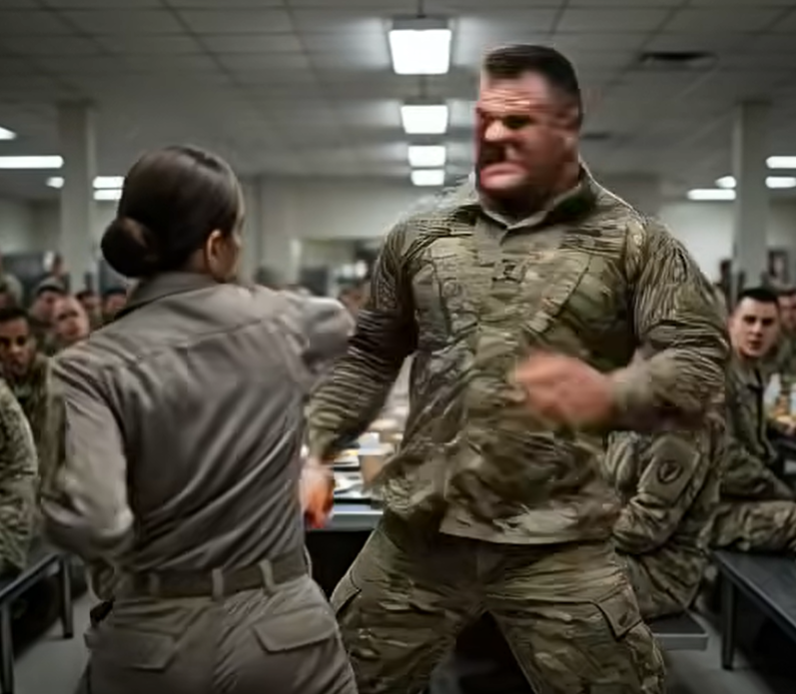
“Die, B*tch,” He Spat, Swinging a Massive Fist in the Mess Hall. He Thought I Was an Easy Target — He Had No Idea He Just Attacked a Classified SEAL Shadow Operative.
I was running on fumes. Seventy-two hours of off-the-books reconnaissance in the frozen Alaskan wilderness had left every muscle screaming. My joints ached from crawling through ice-crusted snow, my eyes burned from staring through night-vision gear, and the only thing keeping me upright was the promise of a hot meal and twelve hours of blackout […]
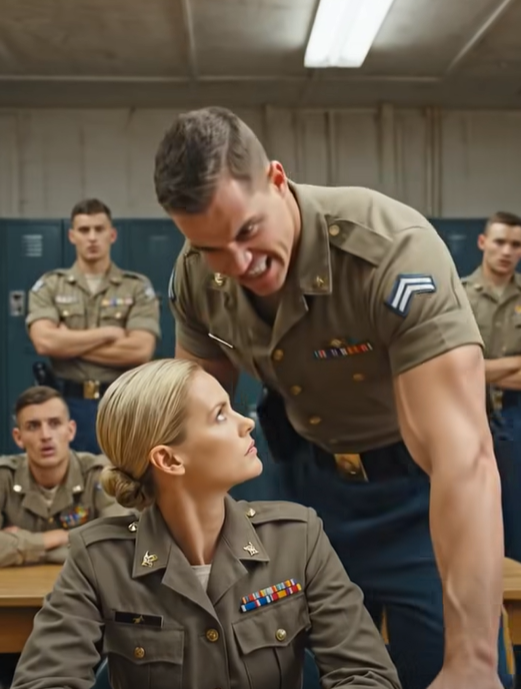
“Do You Know Who I Am?” He Pushed Her — Seconds Later, One ID Card Ended His Career
The dim lights of Rusty’s Bar flickered like dying stars just outside Camp Pendleton. It was a Friday night, the kind where Marines came to forget the sand and the screams they carried home from deployment. I had come here for the opposite reason — to disappear. My name is Commander Thalia Renwick. Highly decorated […]
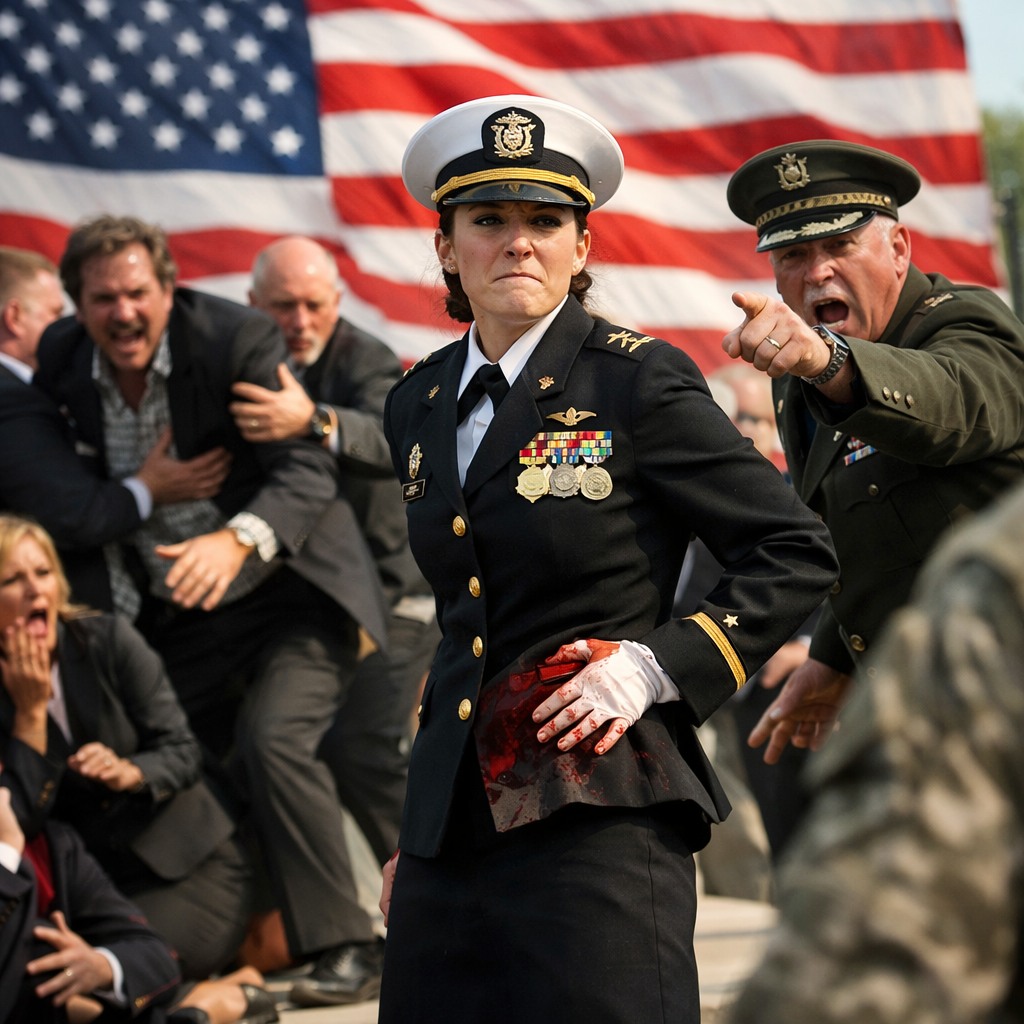
15 Years After My Dad Kicked Me Out, I Saw Him At My Sister’s Wedding. He Sneered: “If It Wasn’t For Pity, No One Would’ve Invited You.” I Just Smiled And Sipped My Wine. Then The Bride Took The Mic And Changed Everything.
The South Carolina sun was merciless that June afternoon, turning the outdoor wedding venue into a glittering oven. I stood near the back in my crisp Army dress uniform, the brass buttons and medals catching the light with every breath. At 34 years old, I had come home for my little sister’s wedding — the […]
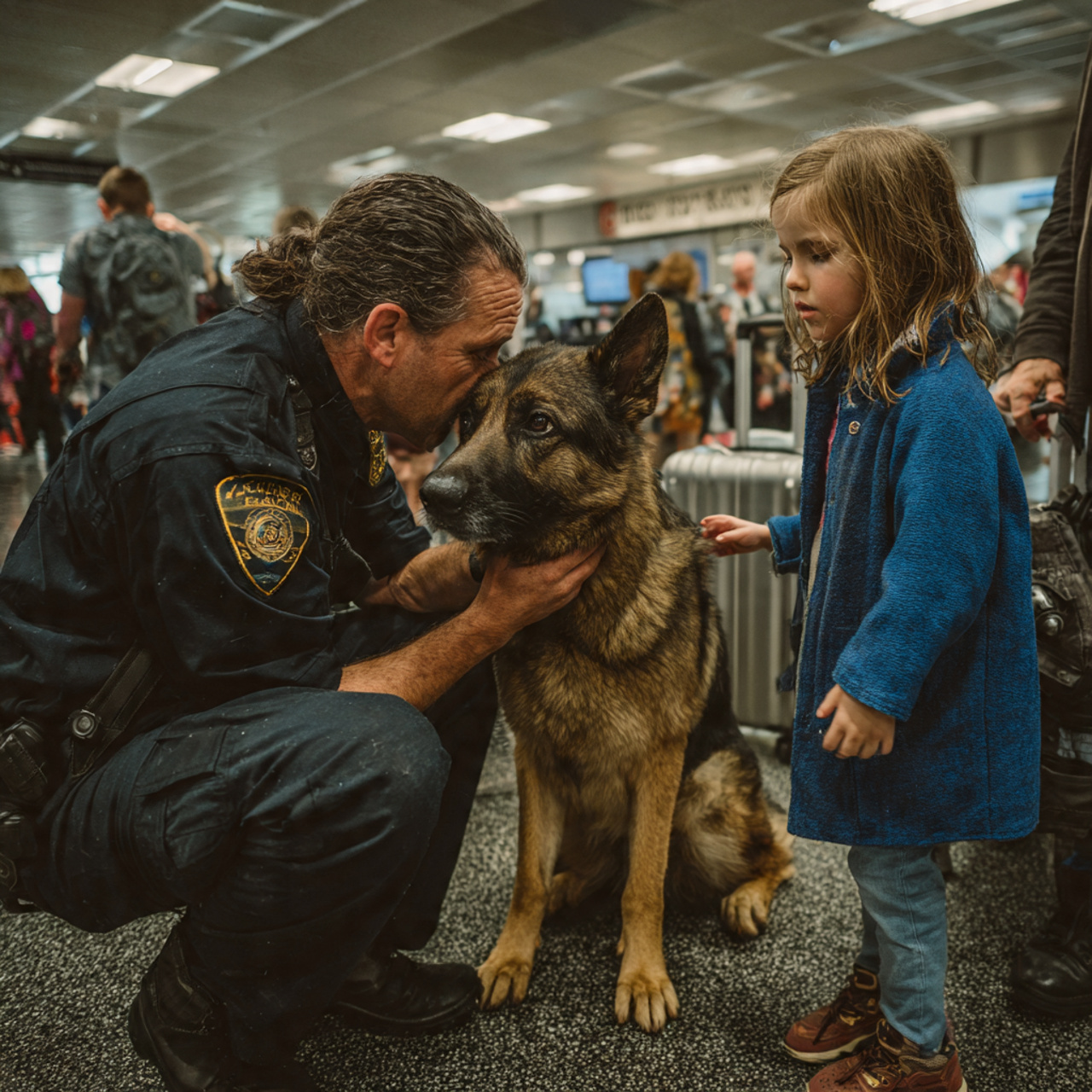
“A POLICE DOG FROZE IN THE AIRPORT. THEN A LITTLE GIRL TAPPED HIS HEAD. WHAT HAPPENED NEXT MADE EVERY TRAVELER STOP. HAVE YOU EVER WITNESSED A SILENT CRY FOR HELP?
The bustling international airport was a whirlwind of rolling suitcases, hurried announcements, and weary travelers rushing to their gates. Officer Liam Mercer patrolled the terminal with his loyal K9 partner, Rex — a highly trained German Shepherd known for his sharp instincts in detection and child safety operations. Everything seemed routine until Rex suddenly froze […]
End of content
No more pages to load